
Kids Screen Time Statistics 2026: 20 Facts With Sources
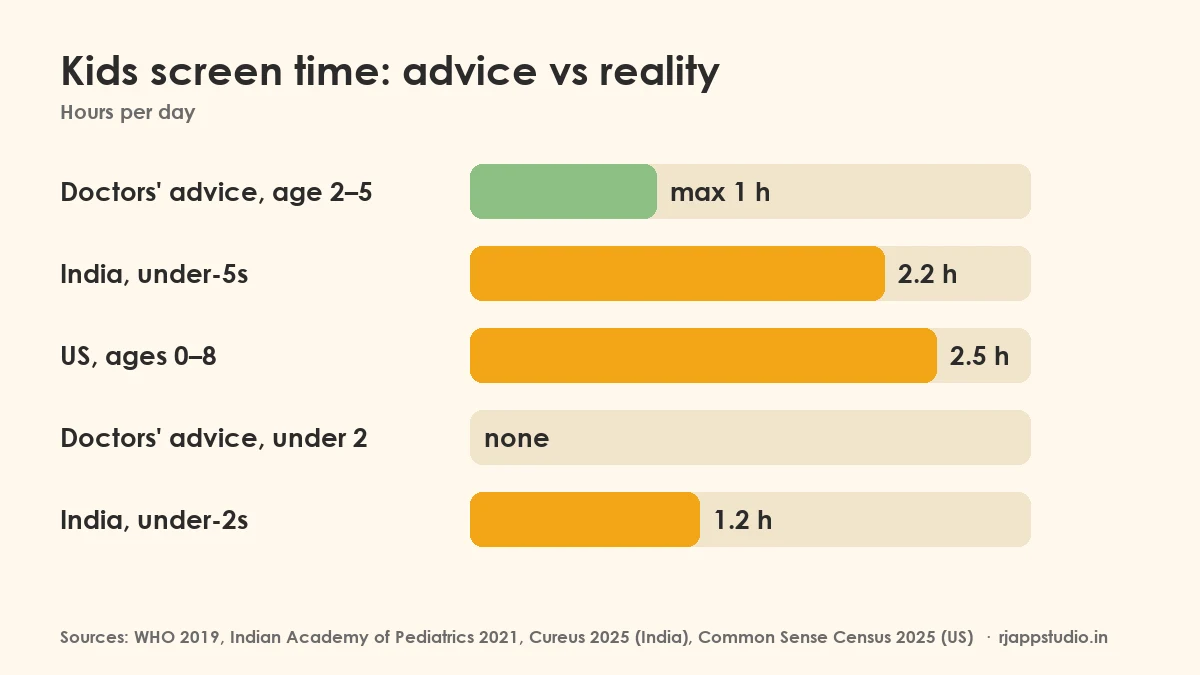
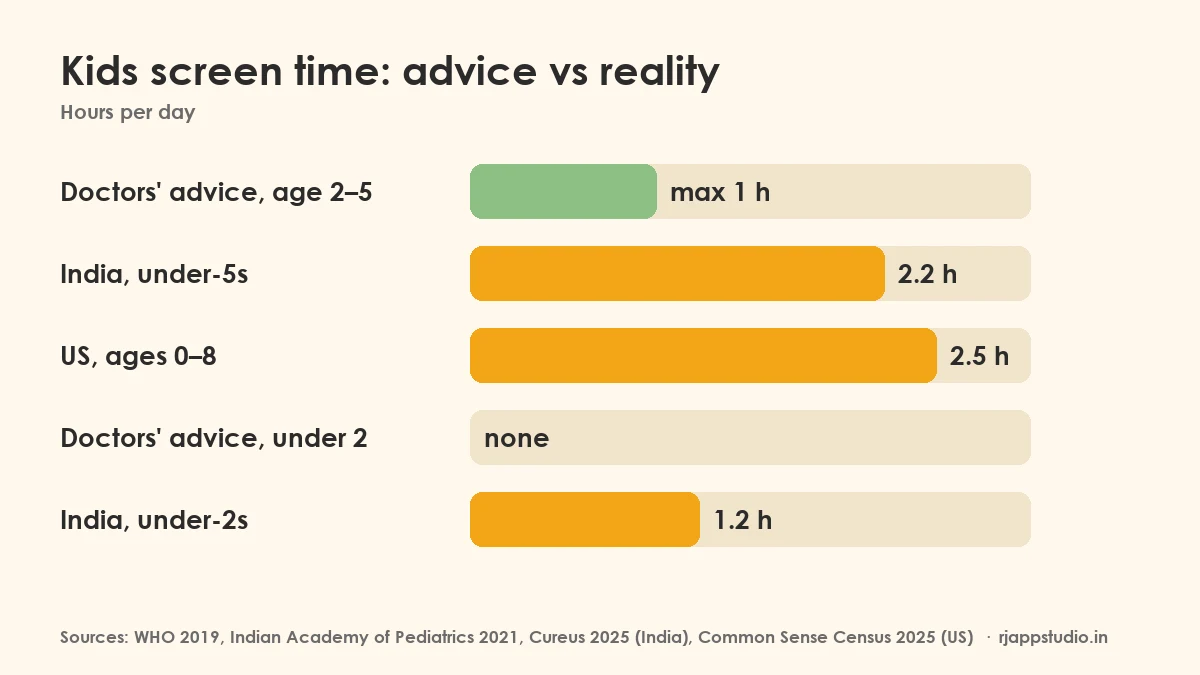
How much time do young children really spend on screens, and how does that compare with what doctors advise? Here are the most useful numbers for parents, teachers and writers. Every fact links to its original source, and the chart is free to use with credit.
The Numbers at a Glance
1. Doctors advise no screen time under age 2 (except video calls) and at most 1 hour a day for ages 2 to 5. — WHO, Indian Academy of Pediatrics 2. US children aged 0–8 average about 2.5 hours of screen time a day. — Common Sense Census 2025 3. Indian children under 5 average 2.22 hours a day — more than double the advised limit. — Cureus, 2025 meta-analysis of 10 studies, 2,857 children 4. Indian children under 2 average 1.23 hours a day, when the advice is none. — Cureus, 2025 5. 40% of US children have their own tablet by age 2, and 58% by age 4. — Common Sense, 2025 6. 1 in 4 children has their own mobile phone by age 8. — Common Sense, 2025 7. 51% of children aged 8 and under have their own mobile device. — Common Sense, 2025 8. Gaming time among young kids is up 65% since 2020. — Common Sense, 2025 9. Children in lower-income US homes spend nearly twice as long on screens (3 h 48 min vs 1 h 52 min a day). — Common Sense, 2025 10. 62% of parents sometimes watch YouTube with their child, but only 17% co-view TikTok. — Common Sense, 2025 11. Daily reading among 5–8-year-olds fell from 64% to 52% since 2017. — Common Sense Census 2025 report, p. 5 12. About three-quarters of parents worry about screen media — and 75% are excited about kids learning through it. — Common Sense, 2025 13. Nearly one-third of parents say their child has used AI for school-related learning. — Common Sense, 2025 14. More screen time at ages 2 and 3 was linked to lower developmental screening scores a year or two later, in a study of 2,441 Canadian children. — Madigan et al., JAMA Pediatrics, 2019 15. In that study, toddlers averaged about 17 hours of screen time a week at age 2 and 25 hours at age 3. — JAMA Pediatrics, 2019 16. 79% of the top kids learning apps on Google Play sell in-app purchases. — RJ App Studio study of 179 apps, 2026 17. 28% of those apps show ads, and only 17% have neither ads nor purchases. — RJ App Studio, 2026 18. 74% carry Google’s “Teacher Approved” badge — and 23% of those still show ads. — RJ App Studio, 2026 19. Only 43% of top kids apps say “No data collected” on their Play Store data safety label. — RJ App Studio, 2026 20. The AAP advises co-viewing: for ages 2 to 5, pick high-quality programmes and watch with your child. — AAP guidance, summarised by ZERO TO THREE
What the Guidelines Say
| Age | WHO (2019) | AAP (US) | IAP (India, 2021) |
|---|---|---|---|
| Under 1 | No screen time | Avoid screens except video calls (under 18 months) | No screens |
| 1–2 years | No sedentary screen time | From 18 months: high-quality media, watched together | No screens (under 2) |
| 2–5 years | No more than 1 hour; less is better (ages 2–4) | About 1 hour a day of high-quality programmes, co-viewed | At most 1 hour a day, supervised |
All three agree on the basics: no screens for babies, and about an hour at most for preschoolers, ideally with a grown-up.
How Much Screen Time Kids Actually Get
The gap between advice and reality is large in both the US and India. US children aged 0–8 average about 2.5 hours a day. In India, a 2025 review of 10 studies found under-fives average 2.22 hours, and even children under 2, who should have none, average 1.23 hours.
What children do on screens is changing too: gaming is up 65% since 2020, and short videos (YouTube Shorts, TikTok) are replacing traditional TV. Meanwhile, daily reading among 5–8-year-olds has dropped from 64% to 52%.
What About Learning Apps?
Parents often see learning apps as “good screen time”. The type of app matters. In our 2026 study of the 179 kids learning apps that Google Play shows for common parent searches, 79% sell in-app purchases, 28% show ads, and only 17% have neither. See the full kids apps study for the method and data.
What Parents Can Do
1. Follow the simple rule: no screens under 2, about 1 hour for ages 2–5. 2. Watch or play together. Talk about what is on screen — it turns watching into learning. 3. Choose quality over quantity. Short, calm, educational content beats endless short videos. 4. Check the labels under the app name: “Contains ads” and “In-app purchases”. 5. Turn on purchase approval in the Play Store (Settings → Authentication) or Google Family Link. 6. Protect reading time. Ten minutes of a printed or read-aloud story every day — try our short moral stories for kids.
For India-specific advice, read our screen time guidelines for toddlers in India.
Use These Statistics
Journalists, teachers and bloggers are welcome to use these statistics and the chart. Please credit RJ App Studio with a link to this page. To embed the chart, copy this code:
Frequently Asked Questions
How much screen time does the average child get?
US children aged 0–8 average about 2.5 hours a day (Common Sense Census 2025). In India, children under 5 average 2.22 hours a day (Cureus, 2025 meta-analysis).
How much screen time is recommended for a 2-year-old?
WHO, the AAP and the Indian Academy of Pediatrics all advise no more than about 1 hour a day for ages 2 to 5, of high-quality content, ideally watched with a parent. Under 2, they advise no screens except video calls.
Is screen time bad for toddlers?
A 2019 study of 2,441 children found that more screen time at ages 2 and 3 was linked to lower developmental screening scores later. It shows a link, not proof of cause, but it is one reason doctors advise limits.
Can I use these statistics in my article?
Yes. Please credit RJ App Studio and link to this page. Each fact links to its original source.