
Screen Time Guidelines for Toddlers: What Indian Paediatricians Actually Recommend (2026)
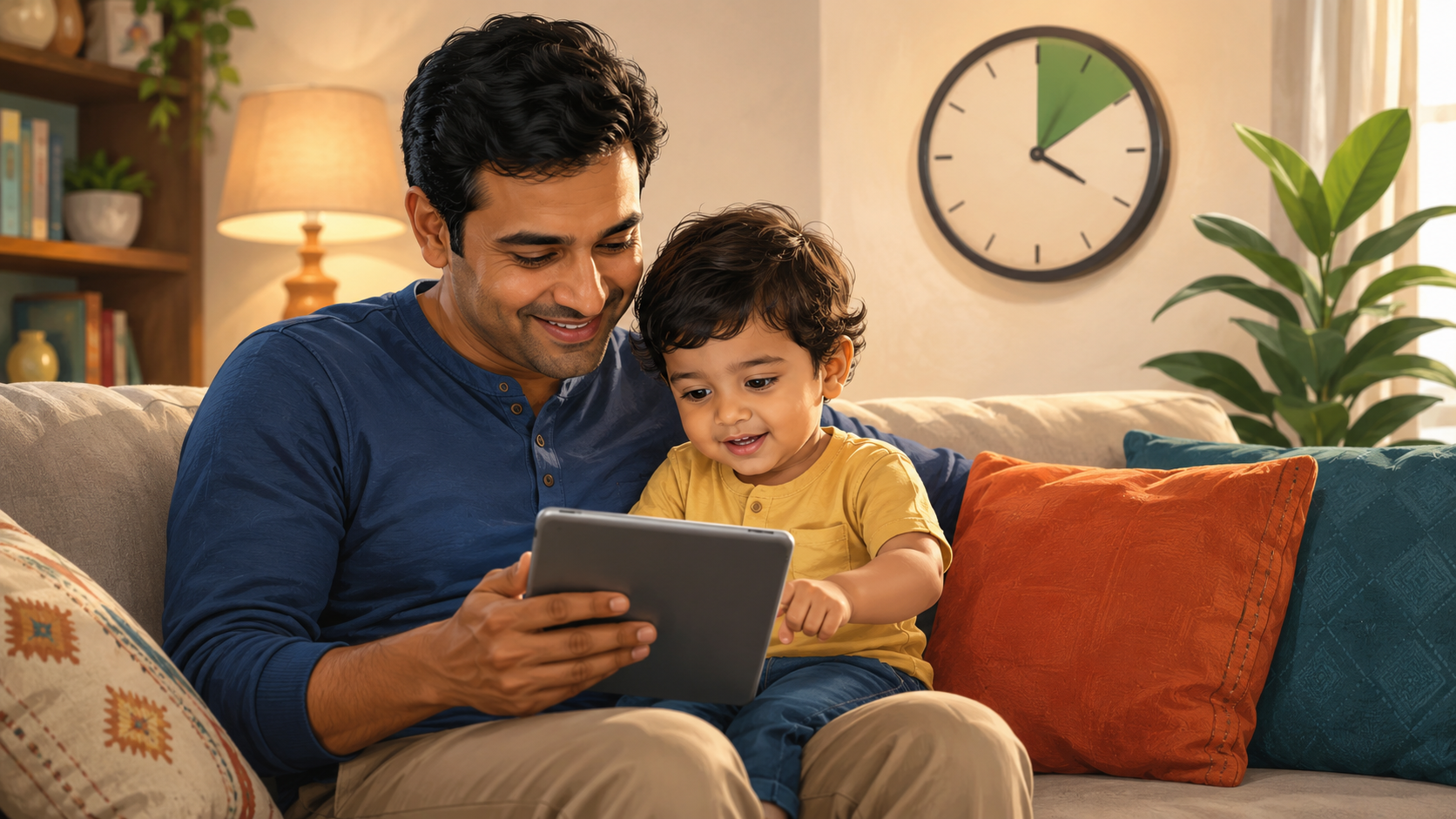
Ask ten Indian parents how much screen time their toddler gets and you’ll hear ten different answers — and a lot of guilt alongside them. The honest truth is that most families use more screen time than the guidelines recommend, and most children turn out fine. But knowing what the evidence actually says (not what WhatsApp forwards claim) helps you make informed choices instead of reactive ones.
Numbers: see kids screen time statistics 2026 — 20 facts with sources.
New data: we checked 179 top kids learning apps on Google Play — 79% sell in-app purchases and only 17% have no ads and no purchases. See the 2026 kids apps study.
This guide covers the official guidelines from the Indian Academy of Paediatrics (IAP) and WHO, what the research shows about different types of screen time, and practical strategies that work for Indian households — joint families, working parents, long commutes and all.
The Official Guidelines (2026)
Indian Academy of Paediatrics (IAP)
The IAP, which is the most relevant authority for Indian parents, recommends:
| Age | Screen Time Recommendation |
|---|---|
| Under 18 months | None, except video calls with family |
| 18–24 months | Very limited; if any, only with a parent watching together |
| 2–5 years | Maximum 1 hour per day of high-quality content |
| 6 years and above | Consistent limits; prioritise sleep, physical activity, and homework |
WHO (World Health Organization)
The WHO guidelines align closely with IAP:
- Under 1 year: No screen time at all
- 1–3 years: Not recommended (if used, only with a caregiver and high-quality content)
- 3–4 years: Maximum 1 hour/day
American Academy of Pediatrics (AAP)
The AAP updated its guidance in 2023 to be less rigid than the old hard limits:
- Under 18 months: Video calls only (FaceTime with grandparents is fine)
- 18 months–5 years: High-quality, educational content; co-view when possible
- Focus on content quality and co-viewing rather than strict minute counting
Why These Numbers Exist: What the Research Actually Shows
The concern isn’t the screen itself — it’s what the screen replaces and how it’s used.
Language development: Studies show that children under 2 learn language significantly better from live human interaction than from video. A 12-month-old watching a native speaker on video doesn’t pick up words the way they would from the same person in the room. This is the “video deficit effect” — children are less efficient learners from screens before about 24 months.
Sleep disruption: Screen use within 1 hour of bedtime delays melatonin onset and reduces sleep quality in children of all ages. Blue light suppression is one factor; mental stimulation is another. This is consistent across studies.
Displacement: The risk of screen time is mainly what it displaces — outdoor play, conversation, reading, physical exploration. A child who watches 3 hours of YouTube has 3 fewer hours of those things.
Passive vs active: Content that requires a child to respond (an app asking “tap the circle!”) is measurably different from content that asks nothing of them. Passive watching, especially autoplay video, has the weakest learning outcomes.
The Indian Context: Why Guidelines Are Harder to Follow Here
Joint family pressure. Grandparents who grew up without television may either resist all screen time, or use it liberally as babysitting with no quality filter. Neither extreme is ideal.
Working parent reality. With both parents working — often with long commutes — screen time frequently fills the gap between school and dinner. A blanket “no screen time” advice ignores this reality.
Heat and monsoon seasons. When it’s 42°C outside or raining heavily, outdoor play isn’t always possible. Screen time expands in these periods for good practical reasons.
Language complexity. Children in India often navigate 2–3 languages simultaneously (English, Hindi, a regional language). Screen time in a single language may slow multilingual vocabulary development if it crowds out exposure to other languages.
Good Screen Time vs Bad Screen Time
The IAP and research both emphasise that not all screen time is equal. A toddler using an interactive learning app for 20 minutes is having a very different experience from watching YouTube autoplay for 90 minutes.
High-Quality Screen Time (Worth the minutes)
- Video calls with grandparents/relatives — real social interaction, responsive conversation
- Interactive educational apps — ask the child to respond, teach specific skills (letters, numbers, shapes), have a clear stopping point
- Co-viewed content — parent watches with the child, narrates, pauses, and discusses
- Offline apps — no ads, no autoplay, content chosen by parent rather than algorithm
Low-Quality Screen Time (Minimise this)
- Autoplay YouTube — algorithm-driven, no natural stop point, ad exposure
- Background TV — disrupts language development even when child isn’t “watching”
- Age-inappropriate content — recommendation drift is real on all platforms
- Solitary, passive, extended viewing — passive, no caregiver input, no stopping structure
Practical Limits for Indian Families (That Actually Stick)
For children under 2:
- Use video calls freely — speaking to grandparents in another city via video is genuinely good for language development
- If using any screen, stay present and treat it like a picture book — narrate and point
- Replace background TV with music or audio stories
For ages 2–4:
- Set a daily screen budget (20–30 minutes for learning apps, 30 minutes max video)
- Use a visible timer — a sand timer or kitchen timer that the child can see makes the limit concrete
- Choose apps over YouTube for educational content — curated, offline, no ads
- Co-view when possible, especially for video content
For ages 4–6:
- Move toward child-directed choices within a menu you’ve pre-approved
- Discuss what they watched — “What did you learn?” makes passive viewing more active
- Keep phones and tablets out of bedrooms at night
- Use screen time as the reward that follows play, not as the default activity
Managing screen time in joint families:
- Agree on limits across all adults in the home — grandparents included
- Frame the limit as doctor’s advice, not parent preference (reduces conflict)
- Offer grandparents alternative engagement ideas (story telling, drawing, outdoor play) that they can substitute for screen time
Signs You May Need to Adjust Screen Time
It’s time to reduce or restructure screen time if your child:
- Has tantrums when the screen is turned off that are disproportionate to the situation
- Prefers screen time over play with other children or adults
- Has trouble sleeping at night (especially if screen use happens close to bedtime)
- Shows reduced interest in physical play, books, or outdoor activities
- Stops making eye contact during mealtimes because of screen habit at the table
None of these alone mean there’s a serious problem — but together, they’re worth addressing through gradual reduction and replacing screen time with structured alternatives.
What “Quality Time” Looks Like Instead
When parents look for screen-free activities that work at home in India, the options are more plentiful than they feel in the moment:
- Story telling — oral stories in any Indian language, made up on the spot, build vocabulary and imagination without any materials
- Cooking together — measuring, pouring, and stirring are excellent fine motor activities for toddlers
- Sorting activities — sort dal, sort laundry by colour, sort spice jars by size
- Drawing with old newspaper — large surface, crayons, no mess concern
- Clay or atta dough — 10 minutes of kneading and shaping is as good as any educational toy
The RJ App Studio kids apps are built around the principle that when screen time does happen, it should be active, structured, and offline. Apps like ABC Kids, 123 Numbers, Phonics & Spelling, and Shapes & Colors each have a defined activity set with no autoplay, no ads, and a natural end point — which makes ending the session easier for both child and parent.
Frequently Asked Questions
Q: My 18-month-old watches 2 hours of YouTube a day. What’s the damage? This is above the recommended level for the age group, but one habit doesn’t determine development. The practical steps are: replace autoplay YouTube with offline learning apps (shorter, structured, no ads), add co-viewing time, and reduce by 15–20 minutes per week rather than going cold-turkey (which rarely holds). Focus on displacement — are they getting sufficient play, talking, and outdoor time?
Q: Is educational YouTube (like ChuChu TV or Cocomelon) okay? It’s better than non-educational video, but autoplay is still a concern and the content is passive. If you use it, watch together, set a specific video list, and disable autoplay manually. Better still, use offline apps for the learning intent and save YouTube for specific co-viewing moments.
Q: Does background TV affect toddlers even if they’re not watching? Yes. Research consistently shows background TV disrupts parent-child conversation — parents talk less and respond less to the child’s vocalisations when a TV is on. Since language development depends directly on adult-child conversation, this has a measurable impact even when the child isn’t “watching.”
Q: My child uses a tablet at school. Does that count toward the daily limit? Most paediatric guidelines refer to recreational screen time, not school-directed use. If your child’s school uses tablets for learning activities with teacher guidance, that’s different from free screen time at home. Still, total daily screen exposure is worth keeping in mind.
Q: Is it too late to cut screen time if my 4-year-old is used to 3 hours a day? Never too late. Gradual reduction works well — cut by 15 minutes every 3–4 days and replace the time with a specific alternative activity (not just “go play”). Children adapt to new routines remarkably quickly once the new routine is consistent for 2–3 weeks.
When screen time does happen, make it count. The RJ App Studio kids learning apps — ABC, Numbers, Phonics, Shapes, Math — are offline, ad-free, and structured with a clear end point, making them the better choice for the minutes your child is on a screen.