
How to Teach a Child to Write Letters: Tracing Step by Step
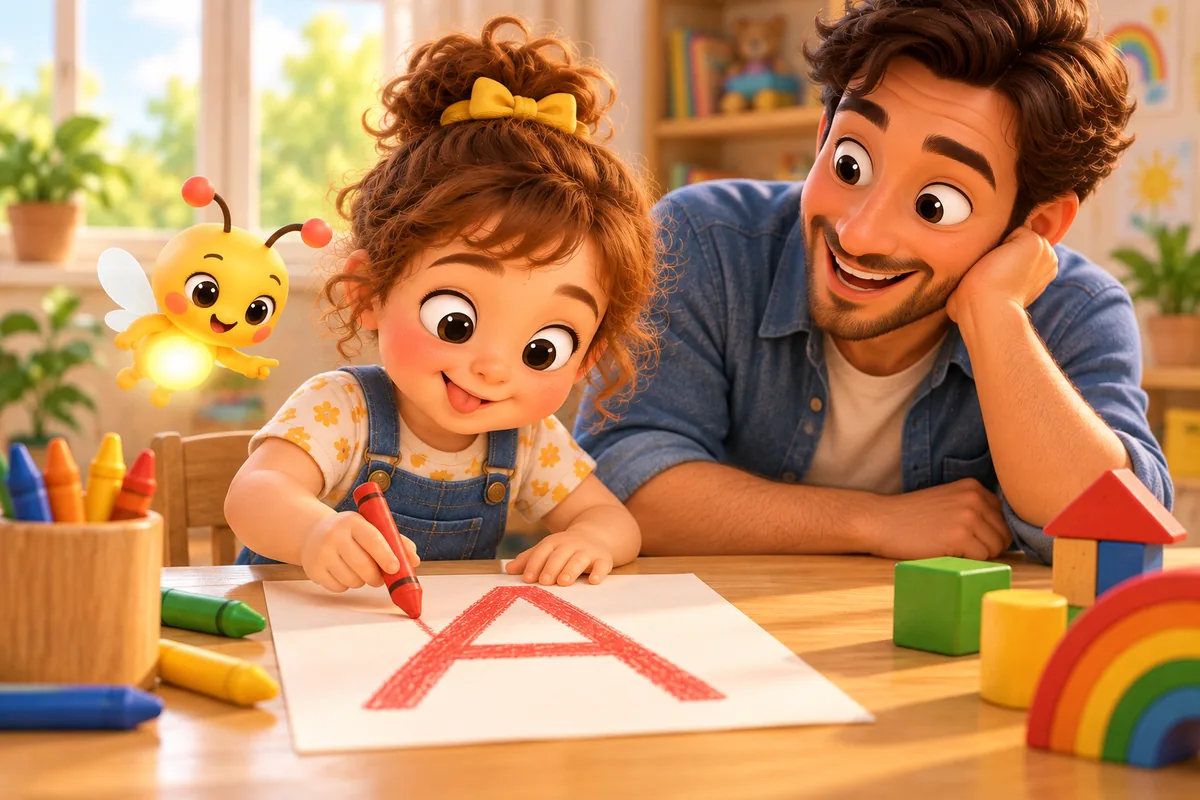
Before a child can write a letter, their hand has to learn a few simple lines: down, across, and round. Letters are just these lines put together. A is two slanted lines and one across. O is a circle. That is why the best way to teach writing does not start with letters at all.
The short answer: First practise lines and circles. Then teach capital letters made of straight lines (L, T, I, H, E, F). Then letters with curves (C, O, S), then slanted ones (A, V, W). Use big movements before small ones — sand, air, chalk, then paper. Most children start writing their name between ages 4 and 5.
Is My Child Ready to Write?
Writing is hard work for small hands. Here are signs your child is ready to start:
- They like to scribble and “draw” with crayons
- They can copy a straight line down and a straight line across
- They can copy a circle
- They show interest in letters, like the first letter of their name
- They can sit for a few minutes to draw or colour
If your child is not ready yet, that is fine. Play-dough, building blocks, and picking up small things all build the hand strength that writing needs.
The Pre-Writing Lines to Learn First
These shapes are the building blocks of every letter. Children usually learn to copy them in about this order. Ages are rough — many children are earlier or later.
| Shape | Many children can copy it by | Letters that use it |
|---|---|---|
| Line down (top to bottom) | 2–3 years | L, T, I, H, E, F |
| Line across (left to right) | 2½–3 years | T, E, F, H, L |
| Circle | 3 years | O, C, Q, G, a, d |
| Cross (+) | 4 years | t, T, f |
| Square | 4–5 years | E, F, H |
| Slanted lines (/ and \) | 5 years | A, V, W, X, K |
| Triangle | 5 years | A, V |
Practise each shape in a fun way: roads for toy cars (lines), suns and balls (circles), windows (squares).
The Easiest Order to Teach Letters
Teaching A to Z in order is not the easiest way. A has slanted lines, which are hard. Group letters by the lines they use instead.
Capital letters
1. Straight lines: L, T, I, H, E, F 2. Curves: C, O, Q, G, S, U, J, D, P, B, R 3. Slanted lines: V, W, X, A, K, M, N, Y, Z
Small (lowercase) letters
Small letters are best taught in families that start the same way:
- “Round” letters start like a C: c, a, d, g, o, q
- “Tall” letters start with a line down: l, t, i, j, k
- “Bridge” letters go down, up and over: r, n, m, h, b, p
- The rest: e, s, f, u, y, v, w, x, z
Many children learn capitals first because they are made of simpler lines. Most words are written in small letters, so start them soon after — often with the letters in your child’s name.
Big to Small: How to Practise Tracing
Children learn a letter’s shape with their whole body before they can write it small. Move through these steps.
1. Air Writing
Write a giant letter in the air with your whole arm. Say the steps out loud: “Line down. Line across at the top.” Your child copies.
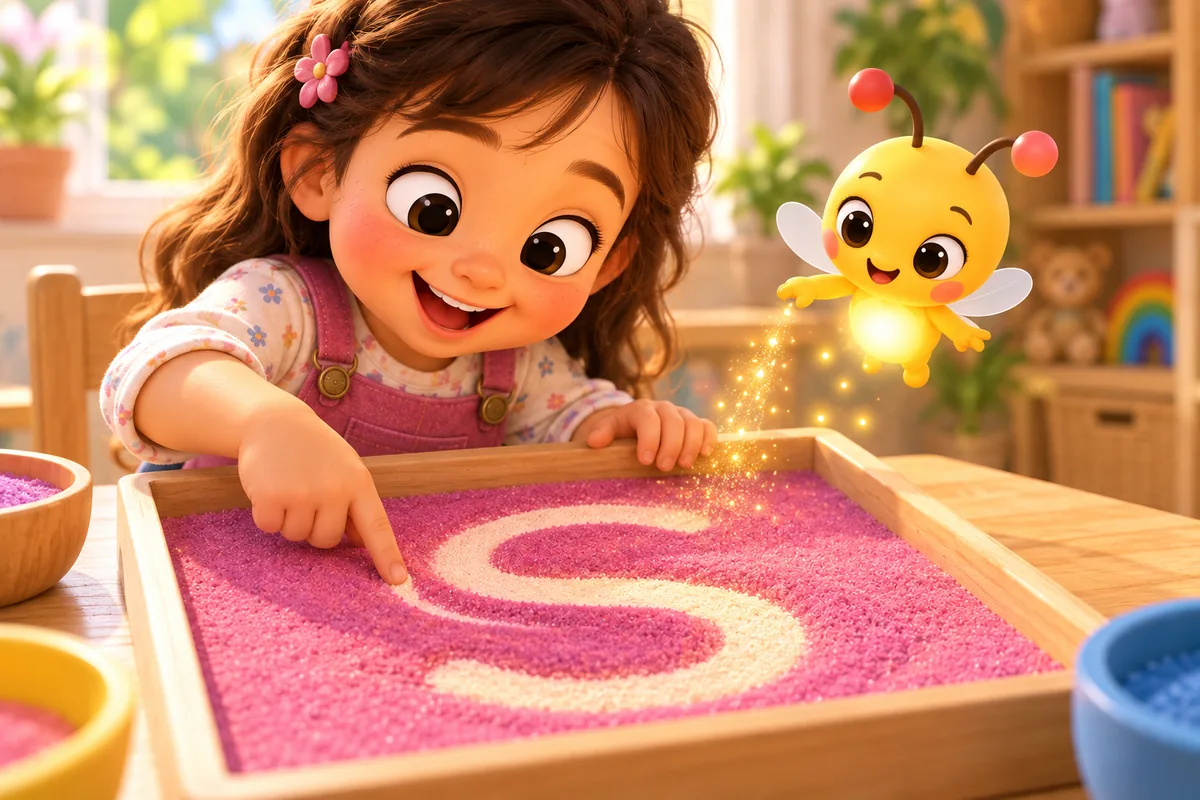
2. Sand or Salt Tray
Pour a little salt, sand or flour on a tray. Your child draws the letter with one finger. Shake the tray to start again. It feels good and there is no “mistake” to rub out.
3. Big Chalk or Paint
Draw big letters on the ground with chalk, or on large paper with paint. Big movements build the shoulder and arm muscles used in writing.
4. Tracing Over Dots
Write the letter in dotted lines and let your child go over it with a crayon. Add a green dot for “start here” and a small arrow for the direction.
5. Copy, Then Write Alone
Write the letter once. Your child copies it next to yours. Later, say the letter and let them try without a model.
Where to Start Each Letter
The start point and direction matter. They make writing faster later, and they stop letters coming out backwards.
- Start at the top. Almost every letter starts at the top, not the bottom.
- Go down first. Lines are pulled down, not pushed up.
- Round letters go anticlockwise. C, O, a, d and g all start at the top and go round to the left (the way the hands of a clock do not go).
Tip: say a short rhyme for each letter. For L: “Line down, then across the floor.”
Pencil Grip: What Is Normal?
- Ages 1–2: A fist grip — the whole hand wraps round the crayon.
- Ages 2–3: Fingers point down, palm faces the paper.
- Ages 4–6: Many children move to a tripod grip: the pencil rests between the thumb and first finger, with the middle finger underneath.
You do not need to force the tripod grip early. Short, thick crayons help, because small hands naturally hold them with the fingertips. Snap a crayon in half — it really works.
Common Mistakes to Avoid
- Starting with pencil and small lines. Big movements come first.
- Too much writing at once. Five minutes is enough for a 3- or 4-year-old.
- Only worksheets. Mix in sand, play-dough letters and chalk.
- Worrying about backwards letters. Writing b for d, or a backwards S, is normal until about age 6 or 7.
- Saying “that’s wrong”. Point to the good part first: “Your line down is so straight! Let’s make the top a bit longer.”
Can Tracing Apps Help?
A tracing app is a good extra, not a replacement for crayons. It can show where each letter starts, which way to go, and it lets your child try again without running out of paper. Many children who will not sit with a worksheet will happily trace on a screen.
ABC Kids Tracing: Letter Fun by RJ App Studio teaches all 26 letters, capital and small, through 15 mini-games. It follows the order children learn: first spotting the letter, then telling it apart from similar letters, then tracing it, then putting letters in order. There are big buttons, no timers, and nothing punishes a wrong tap. It works offline, needs no sign-in, and has no in-app purchases.
After a few minutes on the app, hand your child a crayon and try the same letter on paper. For more ideas, read our guide on how to teach the alphabet to a 3-year-old, and learn the matching letter sounds from A to Z.
Frequently Asked Questions
At what age should a child start writing letters?
Many children start copying a few letters between ages 4 and 5, often starting with the letters in their own name. Before that, drawing lines and circles is the right practice. Some children start earlier, some later.
Should I teach capital or small letters first?
Capital letters are made of simpler lines, so many children find them easier to start with. Small letters are used much more in reading and writing, so bring them in soon after, starting with the letters in your child’s name.
My child writes letters backwards. Should I worry?
No. Backwards letters are very common until about age 6 or 7. Show the start point and direction again, and praise the letters that are right. If it is still happening a lot at age 8, talk to their teacher.
How can I help my child hold a pencil correctly?
Give short, thick crayons or broken crayon pieces — small pieces make the fingers work together. Play-dough, picking up beads and using pegs also build finger strength. Most children reach a tripod grip between ages 4 and 6.
Is tracing on a phone as good as tracing on paper?
It helps with learning the shape and direction of a letter. Paper and crayons also build hand strength and pencil control. The best mix is a few minutes on each.
Want your child to practise letters in a fun way? Get ABC Kids Tracing: Letter Fun on Google Play — 15 letter games, all 26 letters, capital and small, fully offline, for ages 3–6.