
How to Teach Counting 1 to 20: 10 Easy Games for Toddlers
Counting is more than saying “one, two, three”. A child who can say the numbers up to 10 may still not know that five means five things. Real counting has a few small skills inside it, and children learn them one at a time.
The short answer: Start with 1 to 5, not 1 to 10. Count real things your child can touch — toys, stairs, snacks. Point to each thing as you say the number. Play a short counting game every day. Most children can count 10 objects by age 4, and 20 by age 5 or 6.
This guide explains the five stages of counting, what is normal at each age, and ten games that make counting part of your day.
The 5 Stages of Counting
Children usually learn counting in this order. Knowing the stages helps you see what your child needs next.
1. Saying the numbers (rote counting). Your child says “one, two, three…” like a song. It is a good start, but they may not know what the words mean yet.
2. One number for one thing (one-to-one). Your child touches one toy for each number they say. This is harder than it looks. Many children skip a toy or count one toy twice.
3. The last number is “how many”. After counting four cars, your child knows the answer is four. If you ask “How many cars?” and they count again, they are not there yet — that is normal.
4. Knowing the written number. Your child sees 7 and knows it is seven.
5. Comparing and changing. Your child can tell which group has more, and knows that one more than 4 is 5. This is the first step to adding.
What Is Normal at Each Age?
Every child is different. Use this as a rough guide, not a test.
| Age | What many children can do |
|---|---|
| 2 years | Say some numbers, often out of order. Know “one” and “more”. |
| 3 years | Count to 5 or more out loud. Start touching one object per number. |
| 4 years | Count 10 objects correctly. Know “how many”. Recognise some written numbers. |
| 5 years | Count to 20 and beyond. Write some numbers. Understand “one more” and “one less”. |
| 6 years | Count to 100. Add and take away small numbers. |
If your child is a little behind, do not worry. More play is almost always the answer.
10 Easy Counting Games for Toddlers
Each game takes 5 minutes or less. You do not need to buy anything.
1. Count the Stairs
Count out loud on every step, going up and down. Jumping and counting together helps the number stick to the movement.
2. Snack Counting
Give your child five raisins, crackers or pieces of fruit. Count them together, then eat one. “How many now?” This teaches taking away without saying so.
3. Toy Parade
Line up toy cars or animals. Touch each one as you count. Then ask your child to do it. Moving each toy to one side after counting it stops double counting.
4. Clap and Count
Clap three times. Ask your child to copy and count. Then stamp four times, jump two times. Counting sounds and actions is good for children who cannot sit still.
5. Number Hunt
Look for numbers when you are out: on doors, buses, clocks and prices. “Can you find a 3?” This links the written number to the word.
6. Hide and Seek Countdown
Count to 10 (or 20) while your child hides. Then let your child count while you hide. Children love being in charge of the counting.
7. Build a Tower
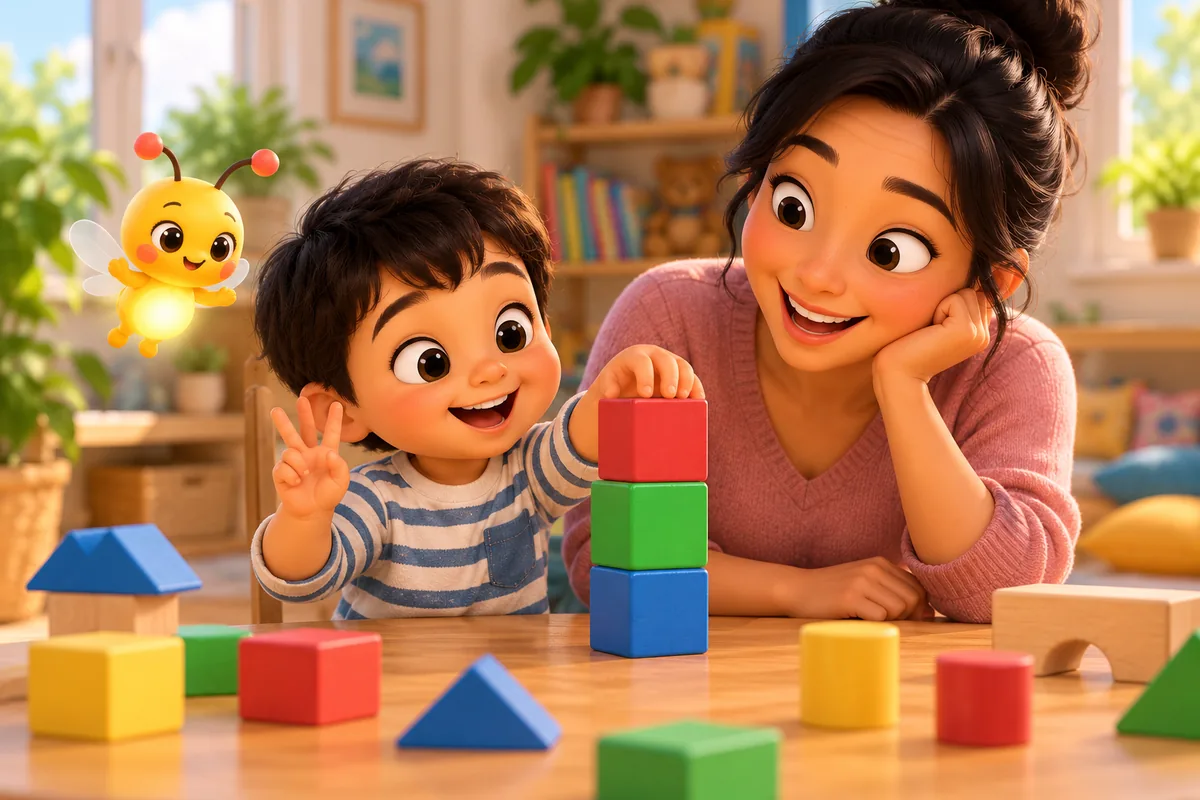
Stack blocks and count each one. How tall can it go before it falls? Count again after it falls: “We had 8 blocks, now we have 0 on the tower!”
8. Which Has More?
Make two small piles of buttons, one with 3 and one with 5. “Which pile has more?” Let your child count both to check. Comparing is a big step in number sense.
9. Number Songs
Songs like “Five Little Ducks” or “Ten in the Bed” teach counting down, which is harder than counting up. Use fingers for each number.
10. Laundry Counting
Count socks as you pair them. Count shirts as you fold them. Everyday jobs become quiet maths practice.
Why the Teen Numbers Are Tricky
Many children count “…eleven, twelve, fifteen, nineteen”. This is very common. In English, the teen numbers do not follow a clear pattern: we say “twenty-one”, but not “ten-one” for eleven.
Help your child with:
- Ten and some more. Show 13 as a group of ten blocks and 3 more blocks. “Ten and three more is thirteen.”
- Say it slowly. Stress the start: “four-teen”, “six-teen”. This shows the link to four and six.
- Count past 20 early. From twenty, the pattern is clear (twenty-one, twenty-two…). Children often find 20 to 29 easier than 11 to 19.
Common Counting Mistakes (and How to Help)
- Counting too fast. Your child says the numbers faster than they point. Slow down together and touch each thing.
- Skipping or counting twice. Move each object after counting it, or put it in a box.
- Starting over when asked “how many”. Count together, then say, “Four! There are four cars.” Stress the last number.
- Mixing up 6 and 9, or writing numbers backwards. This is normal until about age 6 or 7.
Using an App to Practise Numbers
An app should add to real counting, not replace it. A good one says the numbers out loud, lets your child count and tap, and teaches the written numbers too.
123 Numbers Learning Games by RJ App Studio covers numbers 1 to 20 in 55 short levels. Your child counts, traces numbers along a glowing path, finds the right number, compares more and less, solves missing-number puzzles and tries first picture sums. A friendly voice guides every game, so children who cannot read yet can play alone. It has a simple toddler mode (ages 2–4) and a full mode (ages 4–6), works offline, and has no in-app purchases.
Keep screen time short and mix it with the games above. For more on choosing apps, read our parent’s guide to learning apps for ages 2–6. Learning shapes too? See how to teach shapes to toddlers.
Frequently Asked Questions
At what age should a child count to 10?
Many children say the numbers to 10 by age 3, and can count 10 real objects correctly by age 4. Saying the numbers usually comes first. Counting objects correctly takes longer.
My toddler can count to 10 but does not know how many. Is that normal?
Yes, very normal. Saying numbers in order is like singing a song. Knowing that the last number means “how many” is a separate skill that often comes months later. Keep counting real things together.
Should I teach numbers 1 to 10 or 1 to 20 first?
Start with 1 to 5, then 1 to 10. Move to 20 once your child can count 10 objects without mistakes. The teen numbers are harder, so give them extra time.
How can I teach counting without screens?
Use what you already have: stairs, toys, snacks, socks, steps on a walk. Count out loud during the day. Short and often works better than one long lesson.
When should my child write numbers?
Most children start writing some numbers between ages 4 and 5. Tracing numbers with a finger, in sand or on paper, is a good first step. Reversed numbers are normal until about age 7.
Looking for a fun way to practise at home? Get 123 Numbers Learning Games on Google Play — counting, tracing and number puzzles from 1 to 20, fully offline, for ages 2–6.