
100+ Short Moral Stories for Kids (with Lessons): The Complete Collection
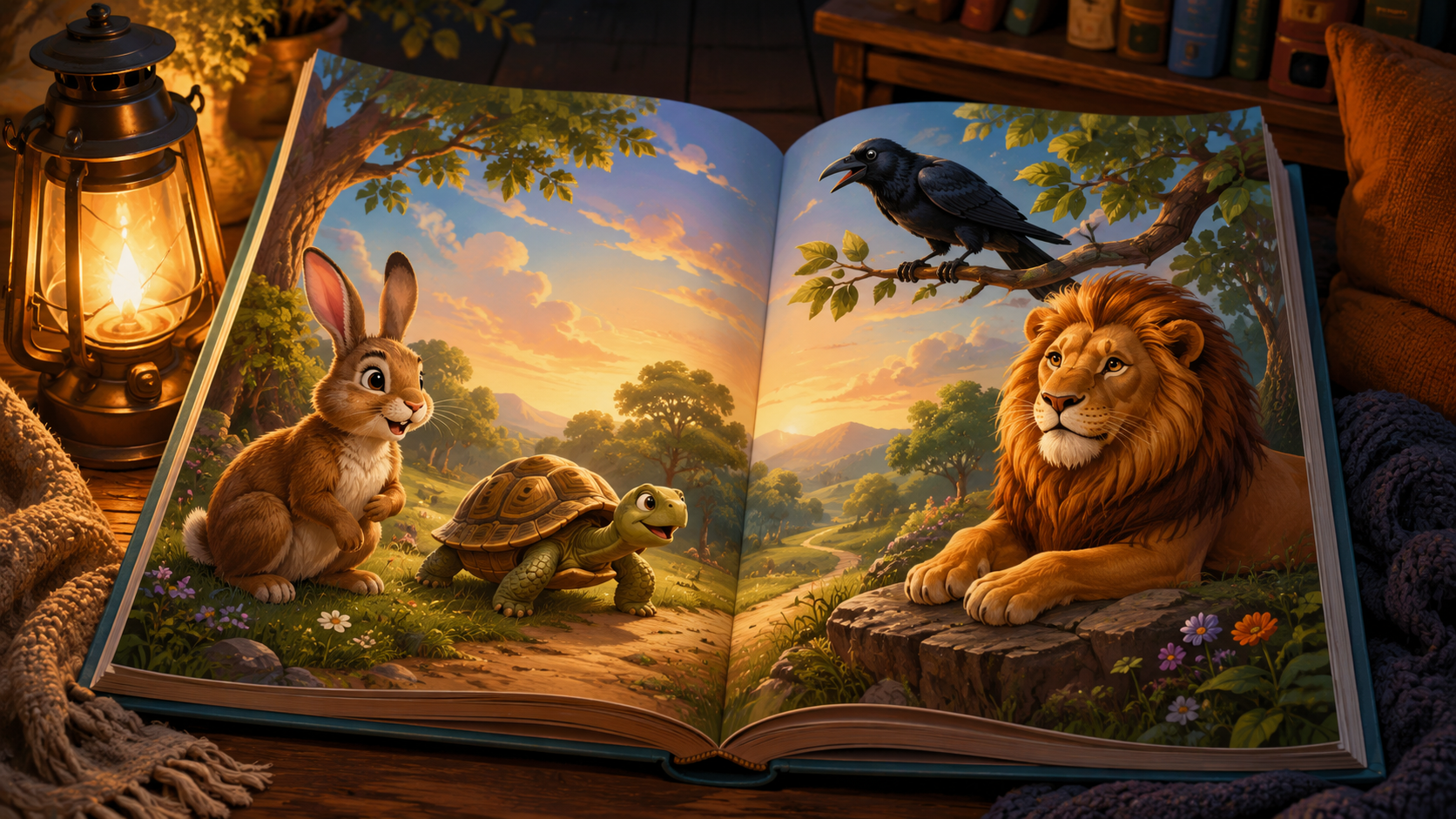
Moral stories have been how humans have passed wisdom to children for thousands of years — long before textbooks, before classrooms, before structured curricula. A 3-minute story about a crow and a pitcher teaches the value of perseverance more vividly than any lecture ever could.
This collection brings together the best short moral stories for children — Indian classics, Panchatantra tales, Aesop’s fables, and original stories — organised by the moral they teach. Use this page to find the right story for the right moment: a lesson about honesty before a school test, a story about kindness after a sibling argument, a bedtime tale about patience and reward.
How to Use This Collection
Each story is tagged with:
- Age suitability — the youngest age the story works well for
- Story length — short (2–3 min), medium (5–7 min), long (10 min)
- Core moral — the primary lesson
For children under 5, choose short stories and read them aloud slowly with expression. For ages 6–10, pause mid-story and ask “What do you think happens next?” — this engages prediction skills alongside the narrative.
Stories About Honesty
1. The Shepherd Boy and the Wolf (Aesop) — Ages 4+ | Short
A shepherd boy, bored on the hill, cried “Wolf! Wolf!” to bring the villagers running — as a prank, twice. When a real wolf came and he cried out, no one believed him. The wolf took the sheep.
Moral: If you lie, people stop believing you — even when you tell the truth.
2. The Axe and the River God (Aesop) — Ages 5+ | Short
A woodcutter dropped his axe in the river. A river god appeared and offered him a golden axe, then a silver axe. The woodcutter said “No — mine was iron.” Impressed by his honesty, the god gave him all three.
A greedy neighbour heard the story and threw his axe in deliberately. When offered the golden axe, he claimed it was his — and the god gave him nothing.
Moral: Honesty earns trust and reward. Greed disguised as honesty earns nothing.
3. The Potter and His Scar (Panchatantra) — Ages 7+ | Short
A potter’s accidental scar was mistaken for a battle wound, earning him a high position at court. When real battle came, his deception was exposed.
Moral: False impressions may bring temporary gain but will always fail in real situations.
4. The Golden Egg Goose (Aesop) — Ages 4+ | Short
A farmer owned a goose that laid one golden egg every day. Greedy for all the gold at once, he killed the goose — and found nothing inside.
Moral: Patience with a good thing brings steady reward. Greed destroys it.
Stories About Cleverness and Quick Thinking
5. The Thirsty Crow (Aesop / Indian Version) — Ages 3+ | Short
A thirsty crow found a jar with water too low to reach. She dropped pebbles one by one until the water rose to the top.
Moral: Where there is a will and creative thinking, there is a way.
6. The Lion and the Hare (Panchatantra) — Ages 5+ | Medium
A clever hare tricks a ferocious lion into jumping into a well after its own reflection.
Moral: Intelligence defeats brute strength. A clever mind can solve what force cannot.
7. The Cap Seller and the Monkeys — Ages 4+ | Short
A cap seller falls asleep under a tree full of monkeys. The monkeys steal his caps. He gets them back by throwing down his own cap — the monkeys imitate him and throw theirs down too.
Moral: Observe behaviour carefully. Sometimes the solution is the opposite of what you first try.
8. The Monkey and the Crocodile (Panchatantra) — Ages 5+ | Medium
A monkey uses quick thinking to escape a crocodile who has been sent to bring the monkey’s heart to his wife.
Moral: Panic clouds judgement. Stay calm and think — even in the most dangerous moment.
9. The Ant and the Grasshopper (Aesop) — Ages 4+ | Short
The ant worked all summer storing food. The grasshopper played music and enjoyed the sun. When winter came, the grasshopper starved while the ant was warm and fed.
Moral: Work and preparation make future security. Pleasure without planning leads to hardship.
10. The Farmer’s Sons and the Field (Aesop) — Ages 6+ | Short
A dying farmer told his sons there was treasure buried in the field. They dug every inch — found no treasure, but the deeply tilled soil produced the best harvest ever.
Moral: Hard work is the real treasure. What looks like a search for gold is really the development of skill and habit.
Stories About Kindness and Compassion
11. The Lion and the Mouse (Aesop) — Ages 3+ | Short
A lion spares a mouse who begs for life. Later, the mouse gnaws through nets to free the trapped lion.
Moral: No act of kindness is too small. The smallest creature can save the mightiest.
12. The Mice and the Elephants (Panchatantra) — Ages 5+ | Medium
A colony of mice asks a herd of elephants to change their route to avoid crushing the mice. Months later, the mice repay the kindness by freeing the elephants from hunters’ nets.
Moral: Kindness shown to even the weakest will find its way back to you.
13. The Boy Who Shared His Lunch — Ages 4+ | Short | Original
A boy at school noticed a friend who had no lunch box. Without being asked, he shared his food — half his rice, half his dal. His friend never forgot it.
Years later when the boy’s family fell on hard times, that same friend’s father helped them find work.
Moral: Generosity creates connections. What you give comes back to you in unexpected ways.
14. The Brahmin and the Cobra (Panchatantra) — Ages 7+ | Medium
A Brahmin’s patience and kindness toward a cobra is rewarded. His greedy son’s aggression destroys the relationship — and can only be partially repaired.
Moral: Trust, once broken by greed, takes much longer to restore than it did to build.
15. The Old Man and His Sons (Aesop) — Ages 6+ | Short
An old man showed his quarrelling sons a bundle of sticks. Separately, each stick broke easily. Together, they could not be broken.
Moral: United we are strong. Division makes us weak and vulnerable.
Stories About Greed and Consequences
16. The Dog and the Bone (Aesop) — Ages 3+ | Short
A dog crossed a bridge with a bone in his mouth. Seeing his reflection in the water, he snapped at the “other dog’s” bone — and dropped his own into the river.
Moral: Greed for what others have can cost you what you already possess.
17. The Blue Jackal (Panchatantra) — Ages 5+ | Short
A jackal dyed blue by accident pretends to be a divine messenger and becomes king of the animals — until his howling gives him away.
Moral: Your true nature always reveals itself. Deception cannot last.
18. Midas and the Golden Touch (Greek Myth) — Ages 5+ | Medium
King Midas is granted the wish that everything he touches turns to gold. His food becomes gold. His beloved daughter becomes gold. He begs for the gift to be taken back.
Moral: Unlimited fulfilment of one desire destroys everything else. Balance is the real gift.
19. The Monkey Who Asked for More (Indian Folk) — Ages 4+ | Short
A monkey helped a farmer clear weeds. The farmer gave him mangoes. The monkey wanted more. He kept working and asking until he collapsed from exhaustion. The farmer had warned him: “Enough is also wisdom.”
Moral: Knowing when you have enough is a kind of richness. Endless wanting brings its own suffering.
Stories About Friendship and Trust
20. The Crow and the Sparrow — Ages 4+ | Short | Original
A crow who was always dismissed as noisy and ugly helped a sparrow whose nest was blown away in a storm — found her new nesting materials, helped her build again. The sparrow had once said she didn’t want crows near her tree. She never said that again.
Moral: Judge a friend by their actions, not their appearance.
21. The Monkey and the Crocodile’s Friendship — Ages 5+ | Medium
The crocodile’s friendship with the monkey is genuine until outside pressure (his wife) tests his loyalty. He chooses poorly — and loses a true friend.
Moral: A friendship tested by external pressure reveals whether it was ever real. Loyalty matters more than convenience.
22. Peace Story: The Two Villages (Original) — Ages 5+ | Medium
Two neighbouring villages quarrelled over a water source for years. A child crossed the boundary to return a toy that had floated to the other side. One small act of kindness began a conversation — which led to a shared solution.
Moral: Peace begins with one small act of goodwill that someone decides to make.
Stories About Patience and Perseverance
23. Robert Bruce and the Spider (Historical Folk) — Ages 7+ | Short
Robert Bruce, hiding in defeat, watches a spider try to swing a web thread seven times. It succeeds on the seventh try. He returns to battle — and wins.
Moral: Try again. Most great achievements come after several failures.
24. The Tortoise and the Hare (Aesop) — Ages 3+ | Short
A fast hare and a slow tortoise race. The hare rests, confident of winning. The tortoise keeps going steadily and crosses the finish line first.
Moral: Slow and steady effort wins over brilliant talent that lacks discipline.
25. The Bamboo Tree (Asian Parable) — Ages 8+ | Short
A bamboo tree shows no visible growth for four years — all its energy goes into building roots. In the fifth year, it grows 27 metres in six weeks.
Moral: Invisible effort creates the foundation for visible achievement. Don’t judge growth by what you can see.
Indian Classics You Shouldn’t Miss
| Story | Tradition | Core Moral | Best Age |
|---|---|---|---|
| Shakuntala and the Ring | Mahabharata | The past always finds us | 8+ |
| The Wise Minister’s Test | Akbar-Birbal | Wit outsmarts authority | 7+ |
| Tenali Rama and the Cursed Well | South Indian folk | One person’s courage protects many | 7+ |
| The Foolish Brahmin’s Dream (Panchatantra) | Panchatantra | Don’t count unhatched eggs | 5+ |
| The Milkmaid and Her Bucket (Indian Aesop) | Folk | Don’t build plans on what you don’t yet have | 5+ |
| The Lion Who Thought He Was a Goat | Indian folk | Know yourself | 5+ |
How to Tell Moral Stories (for Best Effect)
Read slowly. Young children need time to form mental images. Pausing at key moments — “And then… the lion looked down into the well…” — builds suspense and engagement.
Use voices. A squeaky voice for the mouse, a deep voice for the lion. Children light up at vocal differentiation and it holds attention through longer stories.
Ask before giving the moral. “Why do you think that happened?” lets the child discover the lesson rather than receive it. Their version of the moral is often sharper than the official one.
Revisit stories. Hearing the same story at age 4 and again at 8 produces different understanding. The second reading often lands the moral more deeply.
Connect to life. “Remember the story of the Dog and the Bone? Did anything like that happen to you today?” This transforms stories from entertainment into practical wisdom tools.
Frequently Asked Questions
Q: What are the best moral stories for 3-year-olds? For 3-year-olds, choose very short stories (2–3 minutes) with simple, vivid animal characters and a single clear outcome. Best choices: The Thirsty Crow, The Lion and the Mouse, The Dog and the Bone, The Tortoise and the Hare. At this age, the story itself matters more than explicitly stating the moral — let the outcome speak.
Q: Are Aesop’s fables and Indian stories appropriate for Indian children? Both traditions work beautifully for Indian children. Panchatantra and Indian folk stories resonate with familiar settings (forests, villages, animals of the subcontinent). Aesop’s fables work because they’re structurally similar to Panchatantra — many may actually share a common ancient ancestor. Mix both freely.
Q: How often should I tell moral stories? A bedtime story 4–5 times a week is an ideal cadence. Consistency matters more than length. Five minutes of story every night builds vocabulary, comprehension, emotional vocabulary, and moral intuition over months and years.
Q: Can moral stories replace direct teaching about right and wrong? Stories complement — they don’t replace — direct conversation. When a child has actually taken something from a sibling, you still need to address it directly. But a story about The Dog and the Bone read the previous week gives you a shared reference: “Remember the dog who grabbed and lost everything?”
Q: Where can I find more Indian moral stories online? This site’s moral stories collection includes Panchatantra stories, A to Z Alphabet Stories with Lessons, and individual tales like The Cap Seller and the Monkeys and The Thirsty Crow.
For interactive story-based learning that keeps young children engaged while you cook or work, try the Learn & Identify Kids World app — offline, ad-free, and built for ages 2–6.
More Short Moral Stories by Theme
Honesty · Kindness · Friendship · Hard work · Unity is strength · Sharing is caring · Respect · Gratitude · Greed (the greedy dog) · Patience · Helping others · Time management