
How to Calculate Your Electricity Bill in India (2026): A Complete Guide
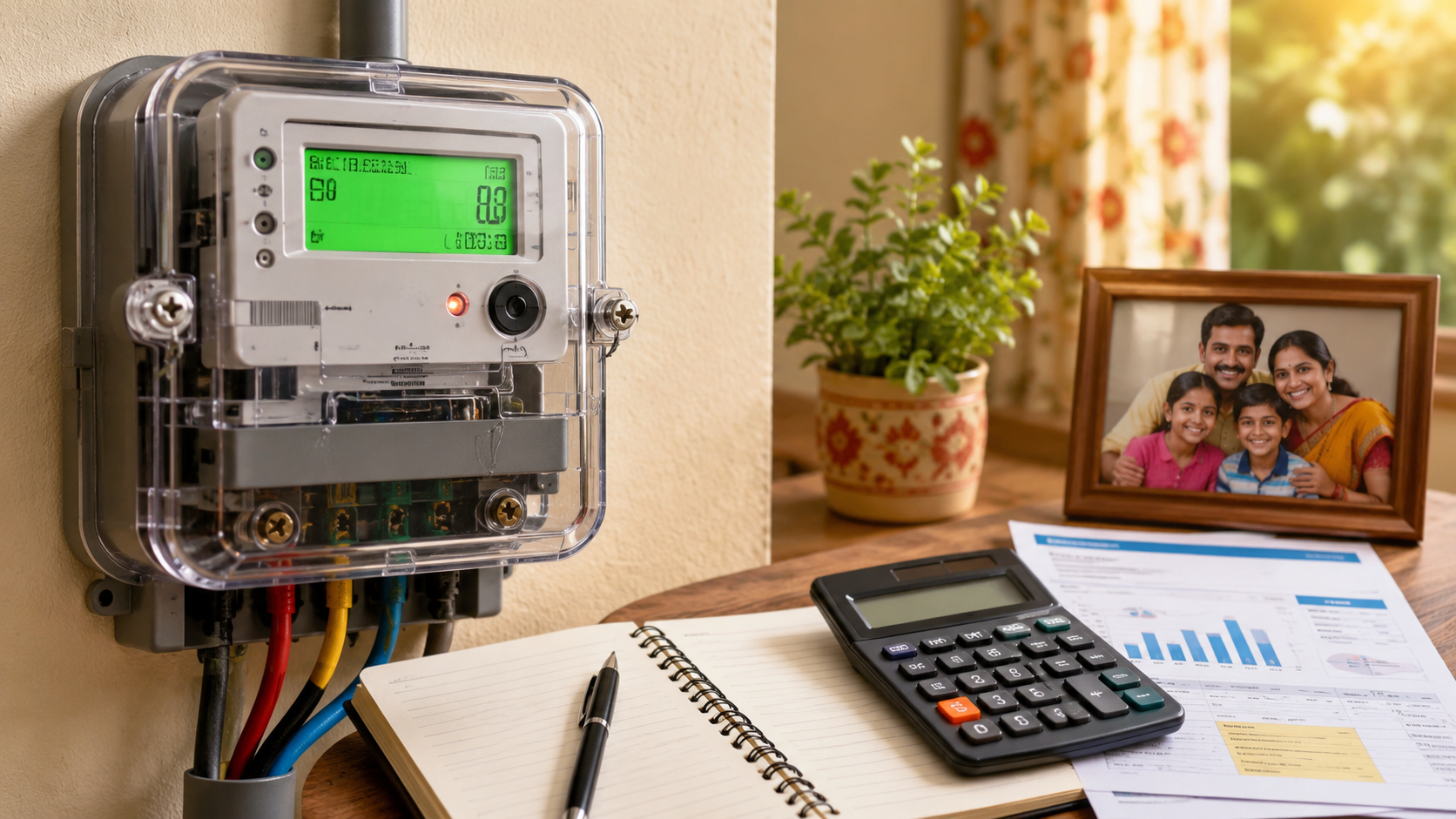
Most Indian families look at their electricity bill once a month, feel vaguely concerned about the number, and pay it without really understanding where it came from. This guide changes that. Once you understand how electricity bills are calculated in India — units, tariff slabs, fixed charges, and seasonal peaks — you can predict your bill before it arrives, identify the appliances costing you the most, and cut your bill by 15–30% with practical changes.
How Electricity Is Measured: Units (kWh)
The unit on your electricity meter is a kilowatt-hour (kWh), often just called a “unit.” It represents the energy consumed by running a 1,000-watt appliance for one hour.
Formula: Energy consumed (kWh) = Power (kW) × Time (hours)
Example: A 100-watt bulb running for 10 hours = 100W × 10h = 1,000 Wh = 1 kWh = 1 unit
To find how many units any appliance uses: 1. Find its wattage (printed on the appliance or in the manual) 2. Multiply by hours of daily use 3. Divide by 1,000 4. Multiply by 30 for monthly units
How Indian Electricity Bills Are Calculated
Your bill is not just units × rate. It has multiple components:
1. Energy Charges (the main variable cost)
This is the per-unit rate multiplied by units consumed. Most Indian states use slab tariffs — the rate increases as you consume more. The first 100 units are cheapest, the next 100 are more expensive, and so on.
2. Fixed/Demand Charges
A flat monthly charge based on your sanctioned load (the maximum power the DISCOM has agreed to supply to your connection). This is charged regardless of consumption. For domestic connections, it’s typically ₹50–₹200/month.
3. Fuel Adjustment Charge (FAC)
An adjustment for fluctuations in fuel costs at power plants. This changes quarterly and is often listed as a small per-unit addition (+₹0.10 to ₹0.30/unit).
4. Electricity Duty / Tax
State government tax on electricity consumption, typically 6–16% of the energy charge.
5. Meter Rent
A small monthly charge for the meter itself (usually ₹10–₹30).
Tariff Slabs: State-by-State Snapshot (2026)
Tariff slabs vary significantly across states. Here are approximate figures for 2026:
| State | 0–100 units | 101–200 units | 201–500 units | Above 500 |
|---|---|---|---|---|
| Maharashtra | ₹3.56 | ₹5.41 | ₹8.87 | ₹10.84 |
| Karnataka | ₹4.10 | ₹5.55 | ₹7.10 | ₹8.50 |
| Delhi | ₹3.00 | ₹4.50 | ₹6.50 | ₹8.00 |
| Tamil Nadu | ₹0 (first 100 free for <250 units/month) | ₹1.50 | ₹3.00 | ₹5.75 |
| Rajasthan | ₹3.85 | ₹5.50 | ₹7.00 | ₹9.00 |
| Uttar Pradesh | ₹3.35 | ₹4.70 | ₹6.15 | ₹7.00 |
| West Bengal | ₹5.41 | ₹6.46 | ₹8.57 | ₹9.56 |
Always check your DISCOM’s current tariff order — rates are revised annually. The above figures are indicative for 2026.
Step-by-Step Example: Calculating a Monthly Bill
Household: 3 BHK in Pune (Maharashtra), 4 members, summer month
Appliances and usage:
| Appliance | Wattage | Hours/day | Units/month |
|---|---|---|---|
| AC (1.5 ton) | 1,500 W | 8 hrs | 360 units |
| Refrigerator | 200 W | 24 hrs | 144 units |
| TV (LED 43″) | 80 W | 5 hrs | 12 units |
| Washing machine | 500 W | 1 hr | 15 units |
| Lights (8 LED) | 8 × 10W = 80W | 5 hrs | 12 units |
| Fans (4) | 4 × 75W = 300W | 10 hrs | 90 units |
| Water heater | 2,000 W | 0.5 hrs | 30 units |
| Laptop/chargers | 100 W | 6 hrs | 18 units |
| Total | 681 units |
Maharashtra tariff (2026) on 681 units:
- First 100 units × ₹3.56 = ₹356
- Next 100 units × ₹5.41 = ₹541
- Next 300 units × ₹8.87 = ₹2,661
- Remaining 181 units × ₹10.84 = ₹1,962
- Energy charge subtotal: ₹5,520
- Fixed charge: ₹150
- Fuel adjustment charge (₹0.20/unit): ₹136
- Electricity duty (16%): ₹883
- Meter rent: ₹15
- Total bill: ~₹6,704
This matches what many Pune families see on a summer month when the AC runs heavily.
The AC Effect: Why Your Summer Bill Spikes
The AC is by far the largest electricity consumer in most Indian homes. In the example above, the AC accounts for 360 out of 681 units — 53% of the entire bill.
More critically, the AC units push total consumption into the higher slabs, making every other unit in the house more expensive too. A household that would otherwise pay slab rate ₹5/unit (201–500 range) now pays ₹10.84/unit (above 500) for everything.
Practical impact: Running the AC 2 fewer hours per night (reducing from 8 to 6 hours) saves 60 units/month from AC alone — but it also pulls total consumption from 681 to 621 units, keeping more units in the cheaper slab. Combined saving: approximately ₹800–₹1,000/month.
Top 10 Ways to Reduce Your Electricity Bill in India
1. Set AC to 24°C — Every degree below 24°C increases AC energy consumption by 6%. The BEE recommends 24°C as the optimal setting.
2. Use a 5-star rated AC — A 5-star rated 1.5-ton AC uses ~1,500W; a 1-star model uses ~2,200W. The difference: 210 units/month, or ~₹1,800 at Maharashtra rates.
3. Switch to LED bulbs — A 60W incandescent bulb replaced by a 10W LED saves 50W. For 5 hours/day, that’s 7.5 units/month per bulb.
4. Use the refrigerator efficiently — Keep it at 3–5°C (not 1–2°C). Clean coils at the back. Keep it 75% full (less air volume to cool). Don’t put hot food directly inside.
5. Run the washing machine on full loads — A half-load uses nearly the same energy as a full load. One full load per week instead of two half-loads cuts laundry consumption by half.
6. Unplug standby devices — TVs, chargers, set-top boxes on standby consume “phantom load” — typically 5–15W each. Across 5 devices, that’s 50–75 units/year just from idle consumption.
7. Use a timer for the geyser — A 2,000W water heater running 2 extra unnecessary hours per day = 120 units/month. Set a timer or switch it off immediately after use.
8. Add ceiling fans before AC — A ceiling fan (75W) cools a room enough to raise comfortable AC temperature by 2–4°C, saving hundreds of units per month without reducing comfort.
9. Check for meter/billing errors — Indian DISCOMs occasionally estimate rather than read meters. Compare your meter reading to what’s on the bill — discrepancies happen and can be disputed.
10. Track your consumption monthly — Families that track energy consumption reduce their bills by 10–15% on average, simply because awareness changes behaviour. An energy tracking app makes this effortless.
Understanding Your Electricity Bill Statement
Here’s what each line item on a typical Indian electricity bill means:
| Line Item | What It Means |
|---|---|
| Opening reading | Meter reading at start of billing period |
| Closing reading | Meter reading at end of billing period |
| Units consumed | Closing − Opening reading |
| Energy charges | Units × per-unit tariff (by slab) |
| Fixed charges | Monthly connection maintenance fee |
| Fuel surcharge | Quarterly fuel cost adjustment |
| Electricity duty | State tax on total energy charges |
| Meter rent | Monthly meter lease charge |
| Arrears/advance | Previous unpaid balance or credit |
Solar Panels and Net Metering: Is It Worth It?
In 2026, rooftop solar with net metering is increasingly viable for Indian homeowners:
- Cost per kWp installed: ₹35,000–₹55,000 (after subsidy)
- Government subsidy: 40% on the first 2kWp, 20% on 2–3kWp (PM Surya Ghar scheme)
- Typical payback period: 4–6 years
- System lifespan: 25+ years
- Net metering allows excess generation to be credited to your bill
For a household consuming 400–700 units/month, a 3kWp system typically offsets 300–400 units, reducing bills by 40–60%. In states like Gujarat, Maharashtra, Karnataka, and Rajasthan, net metering infrastructure is well-established.
Frequently Asked Questions
Q: How do I read my electricity meter? For a digital meter, read the 5 digits displayed (ignoring any digits after the decimal). For an older dial meter, read from left to right — each dial runs 0–9 and the pointer indicates the value. Subtract last month’s reading from this month’s to get units consumed.
Q: Why did my bill jump even though I used the same appliances? Three common causes: (1) An estimated bill last month was lower than actual, so this month corrects it; (2) You crossed a slab threshold — one extra 100 units can push everything above into a higher rate; (3) A tariff revision happened. Check your bill for “arrears” or “adjustments.”
Q: What is the ideal bill amount for a 2BHK Indian flat? Without AC, a 2BHK family of 4 typically consumes 150–250 units/month (₹700–₹1,800 depending on state). With AC running regularly in summer, expect 400–600 units and ₹3,000–₹6,000.
Q: Can I dispute an incorrect electricity bill? Yes. Every DISCOM has a consumer grievance process. For a meter reading dispute, request a re-read in writing. For billing errors, file a complaint via the DISCOM’s app, website, or consumer forum. Under the Electricity Act 2003, you are entitled to a corrected bill within 30 days of a valid complaint.
Q: How can I track my electricity consumption easily? The Energy Tracker app by RJ App Studio lets you log daily appliance usage and automatically calculates projected monthly consumption and cost — useful for spotting which devices are driving your bill before the month ends.
Use the Financial Calculator — SIP, EMI & Tax app for all your household financial calculations — from electricity budgets to EMI planning to SIP projections.