
PPF vs ELSS: Best Tax-Saving Investment for Indians in 2026
Every year, as the financial year draws to a close, millions of Indian salaried employees scramble to fill their Section 80C limit of ₹1.5 lakh. Two of the most popular options? PPF (Public Provident Fund) and ELSS (Equity Linked Savings Scheme). But which one is actually better for you?
The truth is, there is no one-size-fits-all answer. But once you understand the key differences, making the right choice becomes surprisingly simple. Let’s break it down in plain language — no jargon, no confusion.
What is PPF (Public Provident Fund)?
PPF is a government-backed long-term savings scheme that has been around since 1968. You can open a PPF account at any post office or major bank like SBI, HDFC, or ICICI. It is one of the safest investments available to Indian citizens because it is backed by the Government of India.
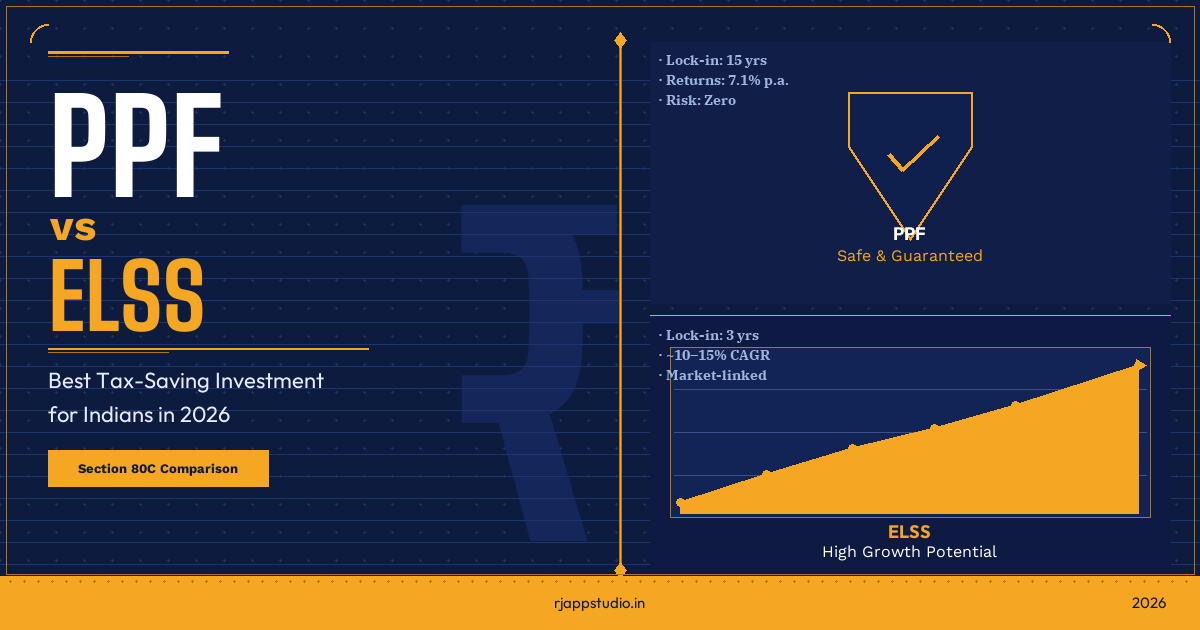
- Lock-in period: 15 years (partial withdrawal allowed from year 7 onwards)
- Current interest rate: 7.1% per annum (compounded annually, reviewed every quarter by the government)
- Risk level: Zero — capital and returns are fully guaranteed
- Tax status: EEE — Exempt on investment, Exempt on interest earned, Exempt on maturity amount
- Investment limit: Minimum ₹500 per year; Maximum ₹1.5 lakh per year
PPF gives you predictable, guaranteed returns with absolutely no market risk. It is especially popular with government employees, homemakers, and anyone who prioritises capital safety over higher returns.
What is ELSS (Equity Linked Savings Scheme)?
ELSS is a type of mutual fund that invests primarily in equities (stocks). It qualifies for tax deduction under Section 80C and has the shortest lock-in period among all 80C instruments — just 3 years.
- Lock-in period: 3 years — the shortest of any 80C investment
- Expected returns: 10%–15% CAGR historically (market-linked, not guaranteed)
- Risk level: Moderate to high — performance depends on the stock market
- Tax status: Investment is tax-exempt; returns above ₹1 lakh per year are taxed at 10% as Long-Term Capital Gains (LTCG)
- Minimum investment: As low as ₹500 per month via SIP
ELSS is the right fit if you are comfortable with market volatility and want the potential for higher, inflation-beating returns over the long term.
PPF vs ELSS: Head-to-Head Comparison
Here is a quick side-by-side look at the two instruments:
- Returns: PPF offers a fixed 7.1% per annum; ELSS can historically deliver 10–15% CAGR but varies with market cycles
- Lock-in period: PPF requires 15 years; ELSS requires only 3 years
- Risk: PPF carries zero risk; ELSS carries market-linked risk
- Liquidity: PPF allows partial withdrawal only after 7 years; ELSS units can be redeemed after 3 years
- Tax on returns: PPF maturity is 100% tax-free; ELSS gains above ₹1 lakh are subject to 10% LTCG tax
- Best for: PPF suits conservative, long-term savers; ELSS suits growth-oriented investors with a higher risk appetite
Real-World Example: ₹1.5 Lakh Invested Over 15 Years
Let’s put numbers to this comparison. Suppose you invest ₹1.5 lakh every year for 15 years:
- In PPF at 7.1%: You would accumulate approximately ₹40.7 lakh — and the entire amount is completely tax-free.
- In ELSS at 12% average CAGR: You could accumulate approximately ₹54.5 lakh — with LTCG tax applicable on gains exceeding ₹1 lakh each redemption year.
On paper, ELSS wins. But remember — those ELSS returns are an average. During market downturns (like 2008 or 2020), your ELSS portfolio could temporarily drop 30–40% in value. PPF will never do that to you.
PPF and ELSS Under the New Tax Regime
This is a crucial point that many Indian taxpayers overlook. If you have opted for the New Tax Regime (NTR), you cannot claim any Section 80C deductions — including PPF and ELSS investments.
Here’s what that means practically:
- If you’re on the old tax regime: Both PPF and ELSS help you save up to ₹46,800 in taxes (30% slab on ₹1.5 lakh investment)
- If you’re on the new tax regime: PPF still makes sense as a safe savings tool, but the 80C tax benefit disappears. ELSS becomes a regular mutual fund with a 3-year lock-in — not necessarily the best choice
Before investing, confirm which tax regime your employer has you under. This single decision changes the entire calculus of PPF vs ELSS.
Who Should Choose PPF?
PPF is the smarter choice if you:
- Are nearing retirement (within 10–15 years) and prioritise capital protection
- Are a first-time investor uncomfortable with market swings
- Fall in the higher income tax bracket (30%) and want guaranteed compounding
- Want a maturity amount that is 100% tax-free with no surprises
- Need a disciplined savings vehicle — PPF’s illiquidity is actually a feature for many
Who Should Choose ELSS?
ELSS is the smarter choice if you:
- Are young (20s or early 30s) with a long investment horizon of 10+ years
- Want inflation-beating returns and are comfortable riding market cycles
- Need liquidity sooner than 15 years — ELSS locks in for just 3 years
- Already invest in PPF and want to add a growth element to your portfolio
- Prefer the convenience of monthly SIPs over annual lump-sum investments
The Smart Indian Investor’s Strategy: Use Both
Many seasoned Indian investors don’t choose between PPF and ELSS — they use both strategically within their ₹1.5 lakh Section 80C limit:
- Invest ₹50,000–₹75,000 in PPF annually for stability, long-term safety, and tax-free guaranteed growth
- Invest the remaining ₹75,000–₹1 lakh in ELSS via monthly SIP for wealth creation and higher potential returns
This approach works especially well for salaried professionals in the ₹6–20 lakh annual income bracket — balancing the need for safety (home loan, kids’ education) with the desire for wealth creation.
Final Verdict
If safety and peace of mind matter more to you — go with PPF. If wealth creation and higher long-term returns are your priority — choose ELSS. And if you want the best of both worlds, split your ₹1.5 lakh wisely between the two based on your age, risk tolerance, and financial goals.
The most important thing is to start early and stay consistent. Whether it is PPF or ELSS, the magic of compounding works best when you give it time and discipline. Don’t wait for the perfect moment — start this financial year and let time do the heavy lifting for you.
Which one are you investing in this year — PPF, ELSS, or both? Let us know in the comments below!