Phonics for Beginners: A Step-by-Step Guide for Indian Parents (2026)
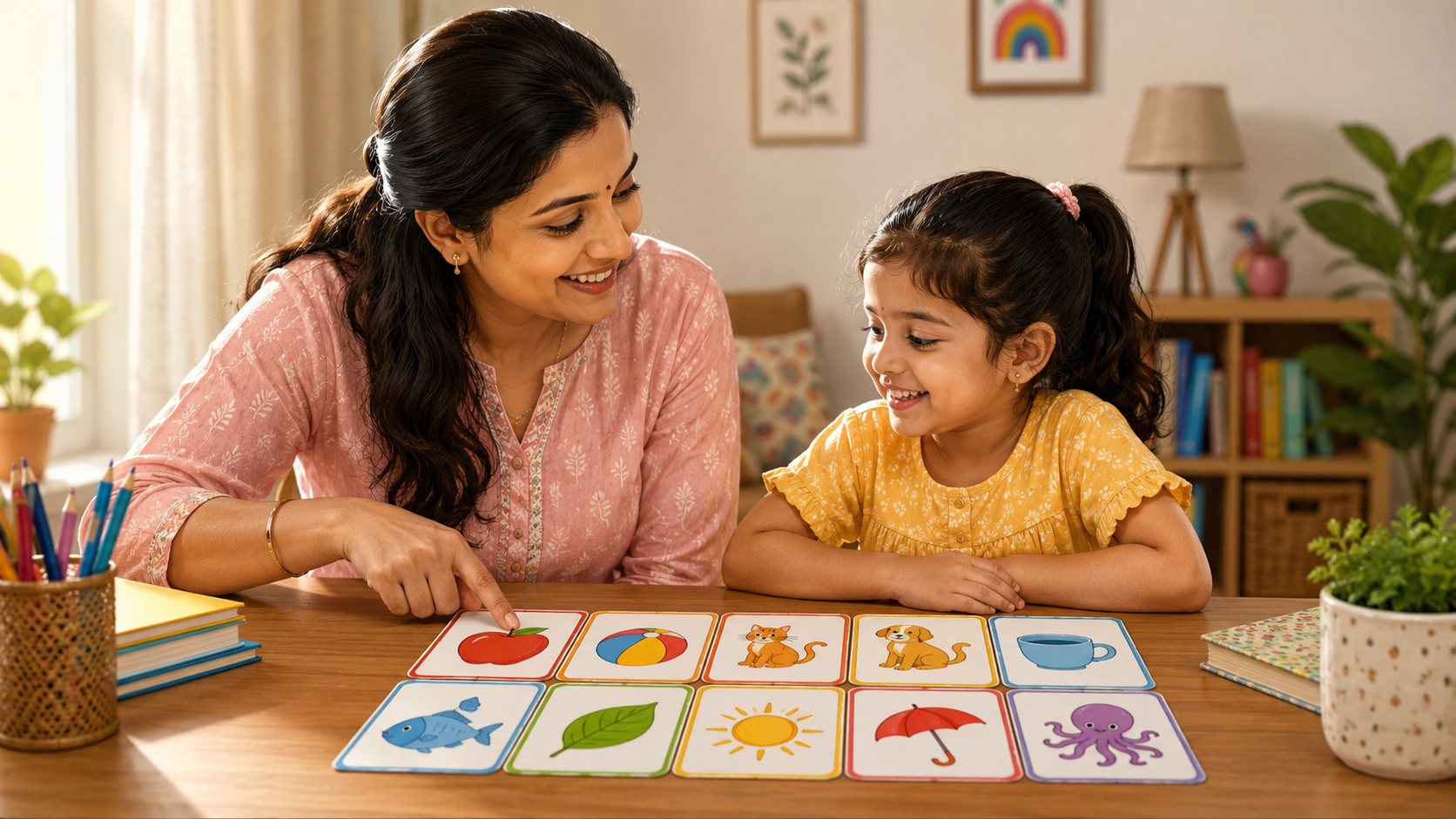
Phonics is how children learn to connect letters to sounds — and it is the single most reliable method for teaching a child to read. If your child can recognise letters but still struggles to read words, phonics is the missing bridge. This guide walks you through exactly how to start teaching phonics at home, no tutor or special equipment needed, in a way that works for Indian families raising children in English, Hindi, or both.
New data: we checked 179 top kids learning apps on Google Play — 79% sell in-app purchases and only 17% have no ads and no purchases. See the 2026 kids apps study.
The short answer: Start with 5 consonant sounds (S, A, T, P, I), blend them into simple words, then expand one sound group at a time. Twenty minutes a day, three to four days a week, is enough for ages 3–6.
What Is Phonics, and Why Does It Matter?
Phonics is the relationship between written letters (graphemes) and the sounds they make (phonemes). English has 26 letters but 44 distinct sounds — which is why English reading feels harder than it looks.
When children learn by memorising whole words (“sight reading”), they hit a ceiling around 200–300 words. When they learn phonics, they can decode any new word they encounter — even words they’ve never seen — by sounding out its parts. Research consistently shows that children taught with phonics read earlier, with better accuracy, and with greater confidence.
For Indian children learning English as a second (or third) language, phonics is especially useful: it gives them a reliable system to fall back on rather than relying on memory alone.
When Should You Start Phonics?
| Age | What’s Realistic |
|---|---|
| 2–3 years | Songs, rhymes, listening to read-alouds. Not formal phonics yet. |
| 3–4 years | Introduce letter-sound links informally. “S says /s/ like snake.” |
| 4–5 years | Start structured phonics — blending simple 3-letter words (CVC words). |
| 5–6 years | Short vowels, consonant blends (bl, st, cl), digraphs (ch, sh, th). |
Don’t rush. A 3-year-old who can recognise 5 letter sounds is well ahead — formal reading can wait until 4–5.
The 5-Step Phonics Plan for Home Teaching
Step 1: Start with the “SATPIN” Letters
The most widely used beginner sequence is: S, A, T, P, I, N. These 6 letters let you build over 30 real words right away — sat, tip, nap, pin, tan, sip, pit, tin — which gives children immediate reading wins that build confidence.
How to introduce each sound:
- Say the letter name: “This is the letter S.”
- Say the sound: “S makes the /s/ sound — like a snake: sssss.”
- Show a picture: snake, sun, sock.
- Write the letter large and trace it together.
Spend 2–3 days on each new sound before moving on.
Step 2: Blend Sounds into Words (CVC Words)
Once your child knows S, A, T, P, I, N — start blending. CVC stands for Consonant-Vowel-Consonant: simple 3-letter words like SAT, PAN, TIP.
Teaching blending: 1. Say each sound slowly: /s/ … /a/ … /t/ 2. Speed it up gradually: /s-a-t/ → “sat” 3. Let the child try: point to each letter and encourage them to blend
Use magnetic letters or written letter cards on the floor. Physical manipulation helps young children far more than worksheets.
Step 3: Add More Letters in Groups
After SATPIN, teach letters in this order (one group every 1–2 weeks):
| Group | Letters |
|---|---|
| Group 2 | C, K, E, H, R |
| Group 3 | M, D, G, O, U |
| Group 4 | L, F, B |
| Group 5 | J, Q, V, W, X, Y, Z |
Each new letter multiplies the words your child can decode. By the end of Group 3, they can read over 200 simple words.
Step 4: Introduce Digraphs and Blends
Once single-letter sounds are secure, add:
- Digraphs (2 letters, 1 sound): ch, sh, th, wh, ph
- “ch” → chair, chip, much
- “sh” → ship, shop, fish
- “th” → the, this, that
- Consonant blends (2 letters, both sounds): bl, cl, fl, gl, pl, sl, br, cr, dr, fr, gr, pr, tr, st, sp, sn, sw
- “bl” → blue, black, blend
- “st” → stop, star, stamp
Step 5: Long Vowels and Silent E
The final beginner milestone is the “magic e” rule: when a word ends in silent E, the vowel says its name (long sound).
- cap → cape
- pin → pine
- hop → hope
- cut → cute
This single rule unlocks hundreds of everyday words.
Phonics for Indian Children: Special Considerations
Accent and pronunciation: Indian English has different vowel sounds from British or American English. That’s completely fine — the goal is decoding words, not accent perfection. Teach sounds as your child hears them in your home language environment.
Bilingual children: Children learning Hindi (or other Indian languages) alongside English often find phonics easier because many Indian scripts are phonetic by nature. Devanagari, for instance, has a near-perfect sound-letter match. You can use that as an analogy: “Just like ‘क’ always says /ka/, ‘S’ always says /s/.”
Common stumbling blocks:
- Confusing b/d: Make a fist with your left hand — the thumb and finger make a “b”. Fist on the right = “d”.
- The short “a” sound: In Indian English, this is often pronounced differently. Use a consistent example word (ant, apple) and stick to it.
- Silent letters: Don’t introduce these until CVC and digraph patterns are solid. They cause confusion early.
Phonics Activities That Work at Home
1. Sound Sorting Write 3 letters on paper cups. Gather small objects or picture cards and sort them by starting sound. “Does ‘mat’ go with M or S?”
2. Stretchy Words Say a word slowly, stretching each sound like elastic: “mmm-aaa-t.” Ask the child to tell you how many sounds they hear (3 for mat, 4 for stop).
3. I Spy with Sounds “I spy something beginning with /b/.” Works in the car, at the market, anywhere.
4. Build a Word Write letters on small pieces of paper or use magnetic letters. Call out a 3-letter word and ask your child to build it. Then change one letter: “Now change the S to a P — what word do you have?”
5. Phonics App Practice (15 min/day) A well-designed phonics app gives children the structured repetition that’s hard to maintain in home sessions. The Phonics & Spelling Kids Game by RJ App Studio covers all the beginner phonics stages — letter sounds, blending, digraphs — in an interactive game format that keeps 3–6 year olds engaged without requiring parental involvement every minute. It works offline, so there are no ads or autoplay interruptions.
How Long Does It Take?
| Milestone | Typical Timeline (4–5 year olds) |
|---|---|
| SATPIN sounds secure | 2–3 weeks |
| Blending CVC words | 4–6 weeks |
| All single-letter sounds | 3–4 months |
| Digraphs and blends | 5–7 months |
| Reading simple books independently | 6–12 months |
Every child moves at a different pace. The biggest predictor of success is consistency — short, regular sessions beat occasional long ones every time.
Signs Your Child Is Ready to Move to the Next Stage
- Blends 3-letter words without sounding each letter out loud (internalised)
- Reads the same CVC words in different positions without prompting
- Asks “what does that say?” when they see text in the environment
- Attempts to sound out new words independently
When you see these, move to the next letter group or introduce digraphs.
Frequently Asked Questions
Q: My child knows the alphabet but can’t read. Is phonics the answer? Yes. Knowing letter names and knowing letter sounds are different skills. A child can recite A to Z perfectly but still not know that ‘A’ says /a/ in “apple” and /ay/ in “ape.” Phonics builds the sound-letter connection that alphabet knowledge alone doesn’t.
Q: Should I teach phonics in Hindi or English? Start in whichever language your child hears most at home. Phonics skills transfer between languages — a child who learns to blend sounds in Hindi will find English phonics easier, and vice versa. You don’t need to choose.
Q: Are phonics apps good or just screen time? A structured phonics app is active learning — the child is listening, responding, and decoding. This is very different from passive video watching. Limit sessions to 15–20 minutes and pair with physical activities (letter cards, I Spy) for best results.
Q: My child is 6 and hasn’t started phonics. Is it too late? Not at all. Children can start phonics successfully at 6, 7, even older. The sequence is the same; you’ll just move faster because older children have better attention spans and can handle more sounds per session.
Q: How do I know if my child has a reading difficulty (dyslexia)? If a child makes no progress after 6 months of consistent, structured phonics, or consistently reverses letters and sounds despite practice, speak to a developmental paediatrician. Early identification of dyslexia means earlier support — and phonics remains the recommended approach for children with dyslexia too.
Looking for a structured phonics practice tool? The Phonics & Spelling Kids Game covers sounds, blending, and spelling in an offline, ad-free format designed for ages 3–6. Pairs perfectly with the home activities in this guide.