
How to Teach the Alphabet to a 3-Year-Old (At Home)
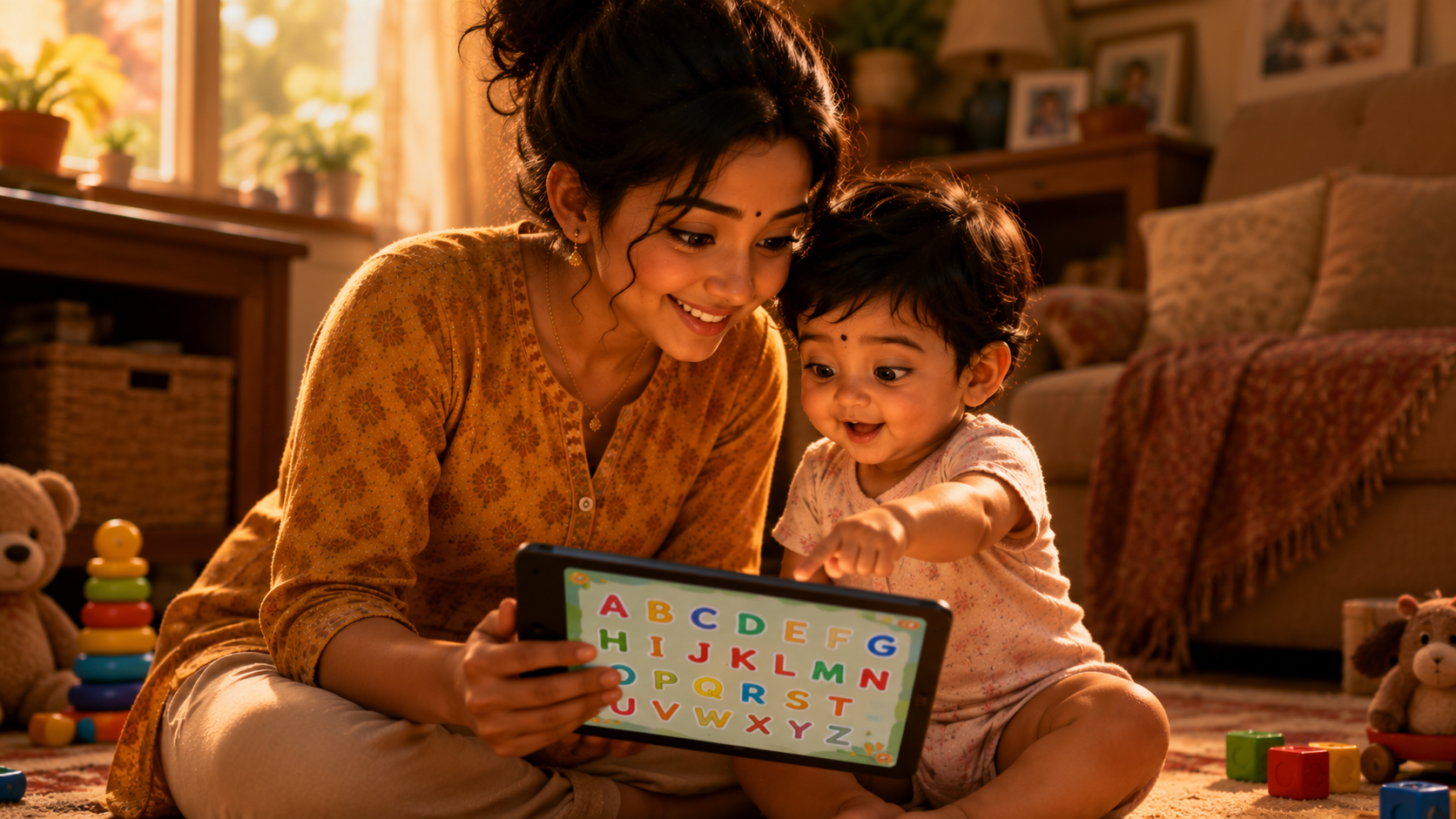
Your 3-year-old doesn’t need to be sitting at a desk to learn their ABCs. The best alphabet learning happens through songs, play, and everyday moments — and most of it can happen at home, right now, with things you already have.
New data: we checked 179 top kids learning apps on Google Play — 79% sell in-app purchases and only 17% have no ads and no purchases. See the 2026 kids apps study.
This guide gives you a simple, pressure-free plan that works for Indian families, whether your child is being raised in English, Hindi, or both.
When Should a Child Know the Alphabet?
Most children start recognising letters between ages 3 and 4, and can name most letters by age 5. At 3, the goal isn’t perfection — it’s exposure and enthusiasm. If your child can spot the letter on a cereal box or shout “A!” when they see it on a sign, they’re right on track.
Don’t compare. Every child has a different pace, and early alphabet recognition doesn’t predict school success. Consistent, joyful exposure does.
The 5 Best Ways to Teach the Alphabet to a 3-Year-Old
1. Sing It — Every Single Day
The ABC song is the oldest trick for a reason: it works. Sing it in the morning, in the car, at bath time. Repetition is how 3-year-old brains wire new information. Once your child knows the tune, start pointing to letters as you sing — this links the sound to the symbol.
Tip: Slow down at “LMNOP.” That’s the part most kids blur into one sound and the part they struggle with most when writing later.
2. Read Alphabet Books Together
Choose books where each letter has a vivid, familiar picture. For Indian kids, look for books that use local words — A for Aam (mango), B for Barfi — to make the letters feel personal. Read the same book multiple times. Repetition is learning, not boredom.
3. Play “Letter Hunt” at Home
Call out a letter and ask your child to find something at home that starts with that sound. “Find something that starts with M!” — milk carton, mat, mom. This turns the whole house into a classroom and builds phonics awareness alongside letter recognition.
4. Use Magnetic Letters or Letter Blocks
Hands-on play with physical letters is powerful for 3-year-olds because they’re tactile learners. Stick magnetic letters on the fridge and spell their name. Ask them to hand you letters. Make it a game, not a lesson.
5. Use a Good Learning App (With You)
A well-designed alphabet app can reinforce what you’re teaching in 10–15 minute bursts. The key word is with you — co-viewing (sitting with your child, commenting on what they see) doubles the learning benefit compared to solo screen time.
Look for apps that are:
- Offline (no autoplay rabbit holes)
- Ad-free (no interruptions)
- Interactive (tapping, tracing, responding — not just watching)
ABC Kids — A to Z Learning Game covers all 26 letters with interactive games, sounds, and animations designed for ages 2–6. It works offline and has no ads.
A Simple Weekly Alphabet Plan for 3-Year-Olds
You don’t need to teach all 26 letters at once. Focus on 2–3 letters per week.
| Week | Focus Letters | Activity Ideas |
|---|---|---|
| 1 | A, B, C | ABC song, “A for Apple” hunt, ABC app |
| 2 | D, E, F | Letter blocks, read an alphabet book |
| 3 | G, H, I | Magnetic fridge letters, draw the letters |
| 4 | J, K, L | Letter hunt, trace letters in sand/flour |
| 5 | M, N, O | Spell their name with M (or first letter) |
| 6 | P, Q, R | Focus on tricky letters, silly songs |
| 7 | S, T, U | Stamp letters with finger paint |
| 8 | V, W, X, Y, Z | Celebrate — they’ve covered all 26! |
Keep sessions short. 10–15 minutes of focused play is more valuable than an hour of passive exposure.
Teaching the Alphabet in Hindi and English Together
Many Indian parents wonder whether teaching two alphabets at once will confuse their child. Research says it won’t — in fact, bilingual children often develop stronger phonological awareness overall.
The trick is to keep them separate contextually:
- English letters in one activity (e.g., the app or English books)
- Hindi/Devanagari in another (e.g., Hindi nursery rhymes, writing practice)
Don’t mix them in the same session when first starting out. Once your child is confident in both, they’ll naturally code-switch.
Signs Your 3-Year-Old Is Ready to Go Further
Once they can name most letters, you can gently move into:
- Letter sounds — “B says ‘buh'” (the foundation of phonics)
- Letter writing — start with their own name
- Simple blending — “C-A-T spells CAT”
For phonics specifically, Phonics and Spelling Kids Game is a natural next step after the alphabet app.
FAQ
At what age should a child know all 26 letters? Most children recognise all 26 letters by age 5–6. At age 3, knowing 10–15 letters is excellent progress. Focus on enjoyment over completeness.
Is it okay to use apps to teach the alphabet? Yes — with a good app and your involvement. Offline, ad-free apps with interactive activities (not just videos) are effective tools when used in 10–15 minute sessions alongside real-world play.
My 3-year-old has no interest in letters. What do I do? Drop the formal approach. Find their interest (animals, vehicles, food) and build letter associations from there. “T for Tiger!” works better than drilling a flashcard.
Should I teach uppercase or lowercase first? Start with uppercase — they’re easier to distinguish visually. Once your child knows most uppercase letters, introduce lowercase slowly. Most reading uses lowercase, so it’s important eventually.
How many letters should I teach per week? 2–3 letters per week is a sustainable pace for a 3-year-old. Quality over quantity — fully understanding A, B, C is better than rushing through all 26.
Ready to make alphabet time your child’s favourite part of the day? Try ABC Kids — A to Z Learning Game — free, offline, and built for ages 2–6.