
SIP vs FD: Which Builds More Wealth in India? (2026 Comparison)
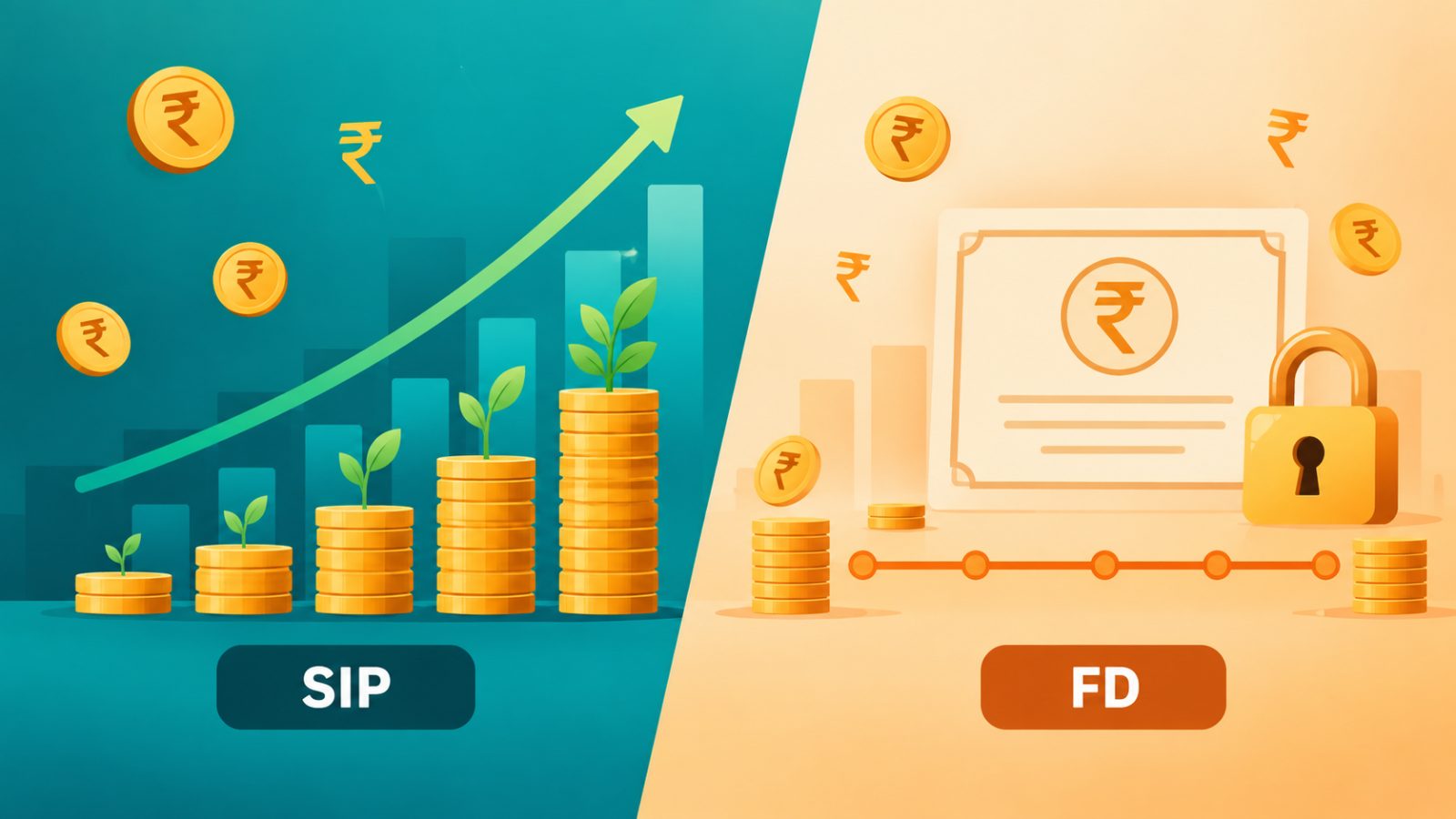
If you have ₹5,000 a month to invest, the choice between a Systematic Investment Plan (SIP) and a Fixed Deposit (FD) makes a real difference to your wealth over 10–20 years. This guide walks through the actual numbers — not just theory — so you can decide which fits your goal.
Short answer: For goals 5+ years away, a SIP in a diversified equity mutual fund typically builds noticeably more wealth than an FD, even after tax. For goals under 3 years, an FD’s guaranteed return usually wins on safety.
SIP vs FD: The Key Differences at a Glance
| Feature | SIP (Equity Mutual Fund) | Fixed Deposit |
|---|---|---|
| Returns | 10–14% p.a. (historical average) | 6.5–7.5% p.a. (2026) |
| Guarantee | No — market-linked | Yes — bank-guaranteed |
| Liquidity | High (redemption in ~3 days) | Low (penalty for early exit) |
| Tax on gains | LTCG 12.5% above ₹1.25L/year | Fully taxable at your slab rate |
| Best for | Goals 5+ years away | Goals 1–3 years away |
| Minimum | ₹500/month | ₹1,000 (most banks) |
Real Numbers: ₹5,000/Month Over 10 Years
Run the actual math instead of relying on general advice.
SIP in an Equity Mutual Fund (assumed 12% p.a.)
- Monthly investment: ₹5,000
- Duration: 10 years
- Total invested: ₹6,00,000
- Estimated value: ~₹11.6 lakh
- Profit: ~₹5.6 lakh
Recurring Deposit / FD (7% p.a., monthly compounding)
- Monthly contribution: ₹5,000
- Duration: 10 years
- Total invested: ₹6,00,000
- Estimated value: ~₹8.7 lakh
- Profit: ~₹2.7 lakh
The SIP builds roughly ₹2.9 lakh more — about a third higher outcome — over the same 10 years. Stretch the same ₹5,000 over a longer horizon and the gap grows fast — see how to save ₹1 crore with a ₹5,000 monthly SIP.
Run this with your own SIP amount and tenure using the SIP Calculator app.
What About Tax?
Tax quietly erodes more wealth than most people account for.
SIP Tax (Equity Mutual Funds)
- Short-term (held under 1 year): 20% STCG
- Long-term (held over 1 year): 12.5% LTCG, but only on gains above ₹1.25 lakh per year
If your annual equity gains stay under ₹1.25 lakh, you pay zero tax on them.
FD Tax
- Interest is added to your total income and taxed at your full slab rate
- In the 30% bracket, you lose 30% of every rupee of FD interest, every year
- TDS is deducted at 10% once interest from one bank crosses ₹50,000 a year (₹1 lakh for senior citizens)
Tax-adjusted comparison (30% tax bracket, 10-year horizon):
| SIP | FD | |
|---|---|---|
| Pre-tax value | ~₹11.6 lakh | ~₹8.7 lakh |
| Tax payable | ~₹53,000 (LTCG on gains over ₹1.25L) | ~₹80,000 (30% on all interest, yearly) |
| Post-tax value | ~₹11.1 lakh | ~₹7.9 lakh |
The gap widens further once tax is factored in — SIP’s tax treatment is simply more favourable for long-term money.
When FD Actually Wins
An FD is the right call when:
- Your goal is under 3 years away — equity markets are volatile short-term, and you can’t risk a dip right before you need the money.
- You need a guaranteed number — for a school fee deadline, a down payment, or an emergency fund, certainty beats upside.
- You’re a senior citizen — senior citizen FD rates (typically 0.25–0.5% higher) plus the higher ₹1 lakh TDS threshold make FDs more competitive for low-risk needs.
- You’re in the 0% tax slab — SIP’s tax edge over FD shrinks considerably if you owe no income tax anyway.
The Smartest Strategy: Use Both
Most Indian households don’t need to pick a side. Match the instrument to the goal:
- Emergency fund (3–6 months’ expenses) → FD or liquid fund
- Short-term goals (wedding, travel, appliance, 1–3 years) → FD or short-duration debt fund
- Long-term goals (retirement, a child’s education, 5+ years) → SIP in an equity mutual fund (for retirement specifically, compare NPS vs PPF vs ELSS)
- Tax-saving (Section 80C) → ELSS (an equity fund via SIP) beats FD on tax savings too — see PPF vs ELSS
How to Start a SIP in India (2026)
- Complete KYC (Aadhaar + PAN-based, done online in about 10 minutes)
- Pick a fund — a Nifty 50 or Nifty Next 50 index fund is a safe starting point for beginners
- Set auto-debit for the 5th or 10th of the month, before spending gets a chance to eat into it
- Start small — ₹500 is enough — and step it up by ~10% a year as your income grows
Don’t wait for the “right time.” A SIP started today beats a better SIP you never start.
FAQ
Is SIP better than FD for the long term? For goals 5+ years away, yes. Historical equity returns (10–14% p.a. for diversified funds) meaningfully outpace FD rates (6.5–7.5%), and the tax treatment on long-term gains widens the gap further.
Can I lose money in a SIP? In the short term, yes — equity markets move up and down. Over 7–10+ years, though, diversified equity mutual funds in India have historically not delivered negative returns; the risk drops sharply the longer you stay invested.
Is FD safe in India? Yes — deposits up to ₹5 lakh per bank are insured by the DICGC. For larger amounts, spread across multiple banks, or consider Post Office FDs, which carry a government backing.
Which mutual fund is best for a SIP in India? Beginners typically start with a Nifty 50 or Nifty Next 50 index fund — low cost and diversified. For more growth potential, flexi-cap or large & mid-cap funds are common next steps. Sector funds are best avoided until you have more experience.
What’s the minimum SIP amount? Most funds accept ₹500/month, and several — including popular flexi-cap and index funds — start at ₹1,000/month.
SIP vs RD — which is better? A Recurring Deposit (RD) behaves like a monthly-funded FD: guaranteed but fully taxable. Over a 5–10 year horizon, an equity SIP tends to beat an RD for the same reasons it beats a regular FD.
Work out exactly how much your SIP will grow — or compare a few scenarios side by side — with the SIP Calculator app. Offline, no account needed, built for Indian investors. More calculators for savings, loans and tax are covered in our complete guide to personal finance calculators for Indians.