Letter Sounds A to Z: A Simple Phonics Guide for Kids
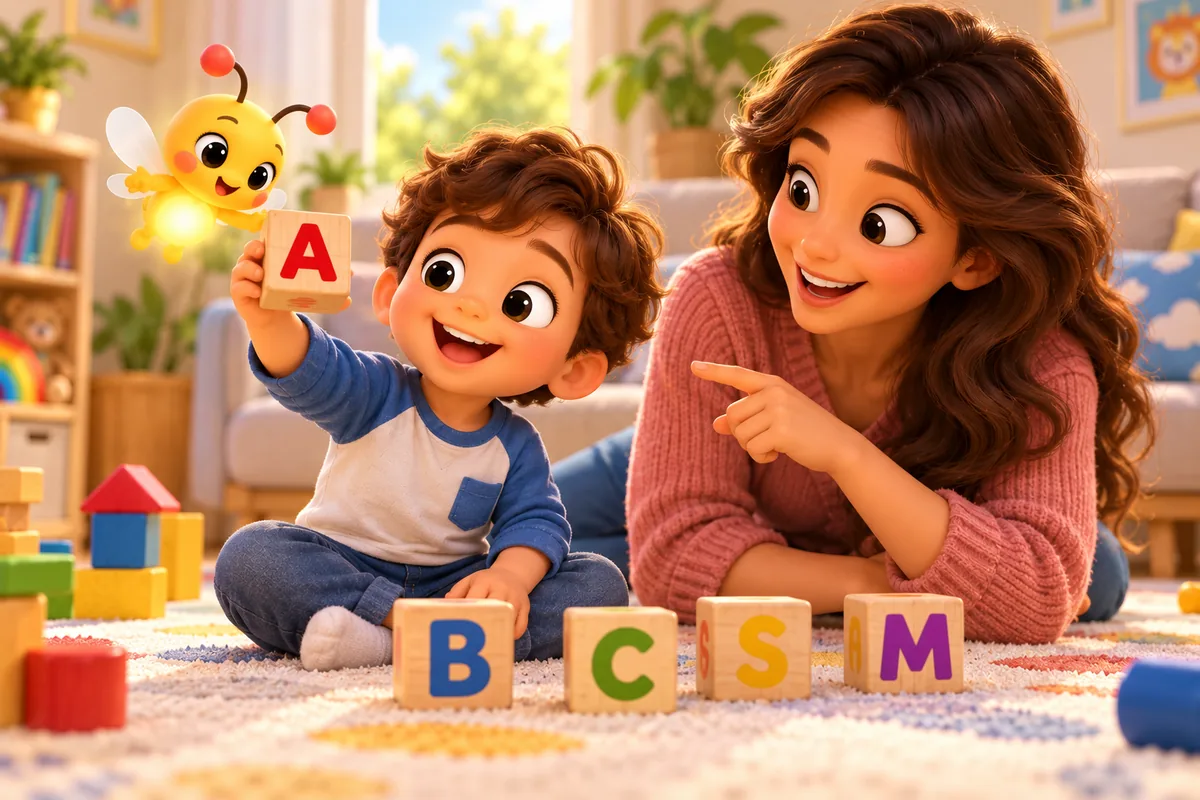
Letter sounds are the sounds each letter makes when we read. The letter B is called “bee”, but in a word it says /b/, as in ball. Children learn to read by joining these sounds together: /c/ /a/ /t/ makes cat. That is phonics.
The short answer: Teach the sound, not the name. Say each sound short and clean (/m/, not “muh”). Start with s, a, t, p, i, n, because they make lots of small words. Play for 10 minutes a day. Most children aged 3 to 5 learn all 26 sounds in 3 to 6 months.
Below you will find every sound from A to Z, the best order to teach them, and six games you can play at home today.
Letter Names vs Letter Sounds
Many children can sing the ABC song but still cannot read a word. That is because the song teaches letter names. Reading needs letter sounds.
| Letter | Name (what we call it) | Sound (what it says in words) |
|---|---|---|
| B | “bee” | /b/ as in ball |
| M | “em” | /m/ as in moon |
| S | “ess” | /s/ as in sun |
| C | “see” | /k/ as in cat |
Both are useful. But if your child is learning to read, the sound matters more. Many teachers now teach sounds first and names later.
How to Say the Sounds the Right Way
This is the most common mistake, and it is an easy fix.
- Keep it short. Say /m/, not “muh”. Say /t/, not “tuh”. The extra “uh” sound makes blending hard: “cuh-a-tuh” does not sound like “cat”.
- Stretchy sounds can be held. Sounds like /s/, /m/, /f/, /l/, /n/ and /v/ can be held for a long time: “sssss”, “mmmmm”. These are the easiest to start with.
- Bouncy sounds are quick. Sounds like /b/, /d/, /g/, /k/, /p/ and /t/ cannot be held. Say them fast and soft, like a tiny cough.
- Short vowel sounds first. A, E, I, O and U each have more than one sound. Start with the short ones: /a/ in apple, /e/ in egg, /i/ in insect, /o/ in octopus, /u/ in umbrella.
All 26 Letter Sounds From A to Z
Use this chart as your guide. The example words start with the sound, so your child can hear it clearly.
| Letter | Sound | Example words | Tip |
|---|---|---|---|
| A a | /a/ | apple, ant, alligator | Short “a”, mouth open wide |
| B b | /b/ | ball, bat, bus | Bouncy — lips pop open |
| C c | /k/ | cat, cup, car | Same sound as K |
| D d | /d/ | dog, duck, drum | Tongue taps behind the top teeth |
| E e | /e/ | egg, elephant, elbow | Short “e”, a small smile |
| F f | /f/ | fish, fan, frog | Stretchy — top teeth on bottom lip |
| G g | /g/ | goat, gift, garden | Hard “g” first (not “giraffe”) |
| H h | /h/ | hat, hen, horse | A soft puff of air |
| I i | /i/ | insect, igloo, ink | Short “i” |
| J j | /j/ | jam, jelly, jump | Quick and bouncy |
| K k | /k/ | kite, king, kangaroo | Same sound as C |
| L l | /l/ | lion, leg, lamp | Stretchy — tongue up behind the teeth |
| M m | /m/ | moon, mouse, milk | Stretchy — lips together, “mmm” |
| N n | /n/ | nest, nose, net | Stretchy — “nnn” |
| O o | /o/ | octopus, orange, ox | Short “o”, round mouth |
| P p | /p/ | pig, pen, pan | Bouncy — a puff of air |
| Q q | /kw/ | queen, quiet, quilt | Almost always comes with U |
| R r | /r/ | rabbit, red, rain | Stretchy — like a little growl |
| S s | /s/ | sun, sock, snake | Stretchy — “sss” like a snake |
| T t | /t/ | tap, top, tiger | Bouncy — tongue taps |
| U u | /u/ | umbrella, up, under | Short “u” |
| V v | /v/ | van, vet, violin | Stretchy — like F with a hum |
| W w | /w/ | web, water, window | Lips round, then open |
| X x | /ks/ | fox, box, six | Heard at the END of words |
| Y y | /y/ | yo-yo, yellow, yak | Quick — “y” at the start of words |
| Z z | /z/ | zip, zebra, zoo | Stretchy — “zzz” like a bee |
The Best Order to Teach Letter Sounds
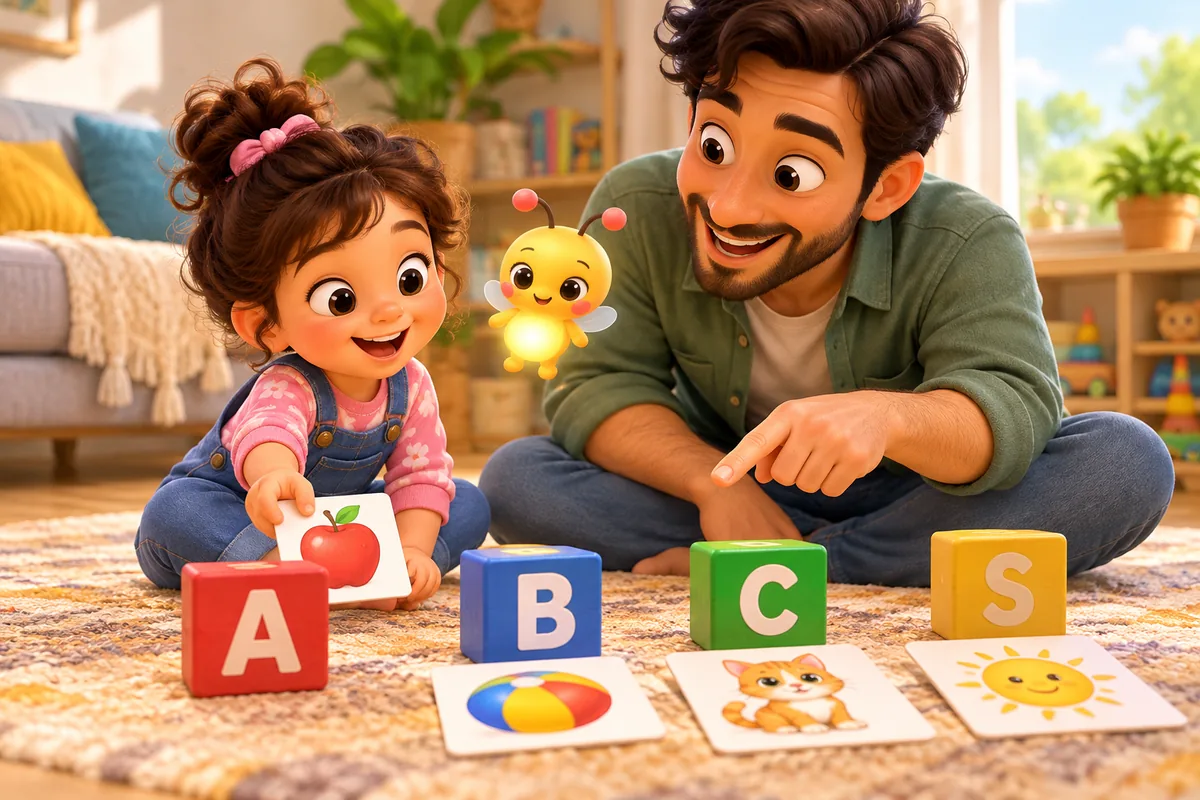
You do not need to teach A to Z in order. In fact, it is better not to. Many schools around the world teach sounds in small groups, so children can read real words after just one week.
Group 1: s, a, t, p, i, n
With just these six sounds, a child can read sat, pat, tap, tin, pin, pan, sit, nap, ant and more. Reading a real word in week one is a huge boost.
Group 2: m, d, g, o, c, k
Now your child can read dog, cat, mop, dig, cot, kid.
Group 3: e, u, r, h, b, f, l
Words like bed, run, hat, fun, leg, bus open up.
Group 4: j, v, w, x, y, z, q
These are used less often, so they come last.
Teach 3 to 4 new sounds a week. Always go back to the old ones first. A quick review of old sounds is more useful than a long lesson on new ones.
6 Letter Sound Games to Play at Home
Short games work better than long lessons. Aim for 5 to 10 minutes, and stop while your child is still having fun.
1. I Spy With Sounds
Say “I spy with my little eye something that starts with /b/.” Your child looks for a ball, a bag or a book. Use the sound, not the letter name.
2. The Sound Basket
Put a basket on the floor with one letter card on it, such as S. Your child walks around the house and finds things that start with /s/: a sock, a spoon, a small toy snake.
3. Mirror Mouths
Sit in front of a mirror together. Say a sound and look at your mouths. Is it open wide (/a/)? Are the lips closed (/m/)? Is there a puff of air (/p/)? Children learn faster when they can see the sound.
4. Sound Hopscotch
Write letters on paper and put them on the floor. Say a sound. Your child jumps onto the right letter. Great for busy children who cannot sit still.
5. Silly Sound Stories
Make up a sentence where every word starts with the same sound: “Sam the snake sat in the sun.” Let your child make one too. The sillier, the better.
6. Robot Talk (Blending)
Once your child knows 5 or 6 sounds, talk like a robot: “Can you give me the /c/ /u/ /p/?” Your child joins the sounds and says “cup!” This is blending, the step that turns sounds into reading.
When Is My Child Ready to Read Words?
Your child is ready to start blending simple words when they can:
- Say the sound for at least 6 to 8 letters without help
- Hear the first sound in a word (“What sound does sun start with?”)
- Join two or three sounds you say out loud (/s/ /a/ /t/ → “sat”)
The first words to read are CVC words: consonant, vowel, consonant. For example cat, dog, pig, sun, bed. They are short, they follow the rules, and there are hundreds of them. Our guide to phonics for beginners goes step by step through blending.
Common Mistakes to Avoid
- Adding “uh” to sounds. Say /b/, not “buh”. This one mistake makes blending much harder.
- Teaching too many sounds at once. Three or four a week is plenty.
- Only using flash cards. Cards are fine, but games, songs and real objects stick better.
- Moving on too fast. If your child forgets old sounds, slow down and review.
- Correcting too much. Praise the effort. “Nice try! Let’s listen again” works better than “No, that’s wrong.”
Using an App to Practise Letter Sounds
A good phonics app gives your child extra practice when you are busy, and it always says the sounds the right way. Look for an app that plays each sound out loud, lets your child trace the letter, and moves from sounds to simple words.
ABC Phonics: Learn to Read by RJ App Studio follows the same path as this guide: sounds first, then words. Stage 1 has 26 short lessons: your child hears each letter sound, traces the letter, finds the matching picture and plays a quick quiz. Stage 2 moves on to building CVC words like cat and pig with letter tiles. It works fully offline, needs no account, and has no in-app purchases. It is made for ages 3 to 7.
Keep app time short — 10 to 15 minutes — and use it next to the games above, not instead of them. For more ideas, see our parent’s guide to learning apps for ages 2–6.
Frequently Asked Questions
At what age should a child learn letter sounds?
Most children are ready between ages 3 and 4. Some start earlier, some later, and both are normal. If your child enjoys the games, they are ready. If they get upset or bored, wait a few weeks and try again.
Should I teach letter names or letter sounds first?
For reading, sounds come first. Letter names are still useful, so it is fine to use both. Just make it clear which one you mean: “This letter is called ‘ess’. It says /s/.”
How long does it take to learn all 26 letter sounds?
With 10 minutes of practice most days, many children learn all 26 sounds in 3 to 6 months. Some take longer. Steady practice matters more than speed.
Why does my child say “buh” instead of /b/?
Most adults were taught this way, so children copy it. Model the short sound yourself: close your lips and let a quick /b/ pop out, with no “uh” after it. Your child will copy you.
What comes after letter sounds?
Blending simple CVC words like cat and sun. After that come two-letter sounds such as sh, ch and th, and then longer words.
Is phonics used in all countries?
Phonics is the main way to teach reading English in the UK, Australia, much of the US, and many English-medium schools across Asia and Africa. The letter sounds are the same everywhere, even if accents differ a little.
Want a fun way to practise at home? Download ABC Phonics: Learn to Read on Google Play — 26 letter sound lessons and first word building, fully offline, for ages 3–7.