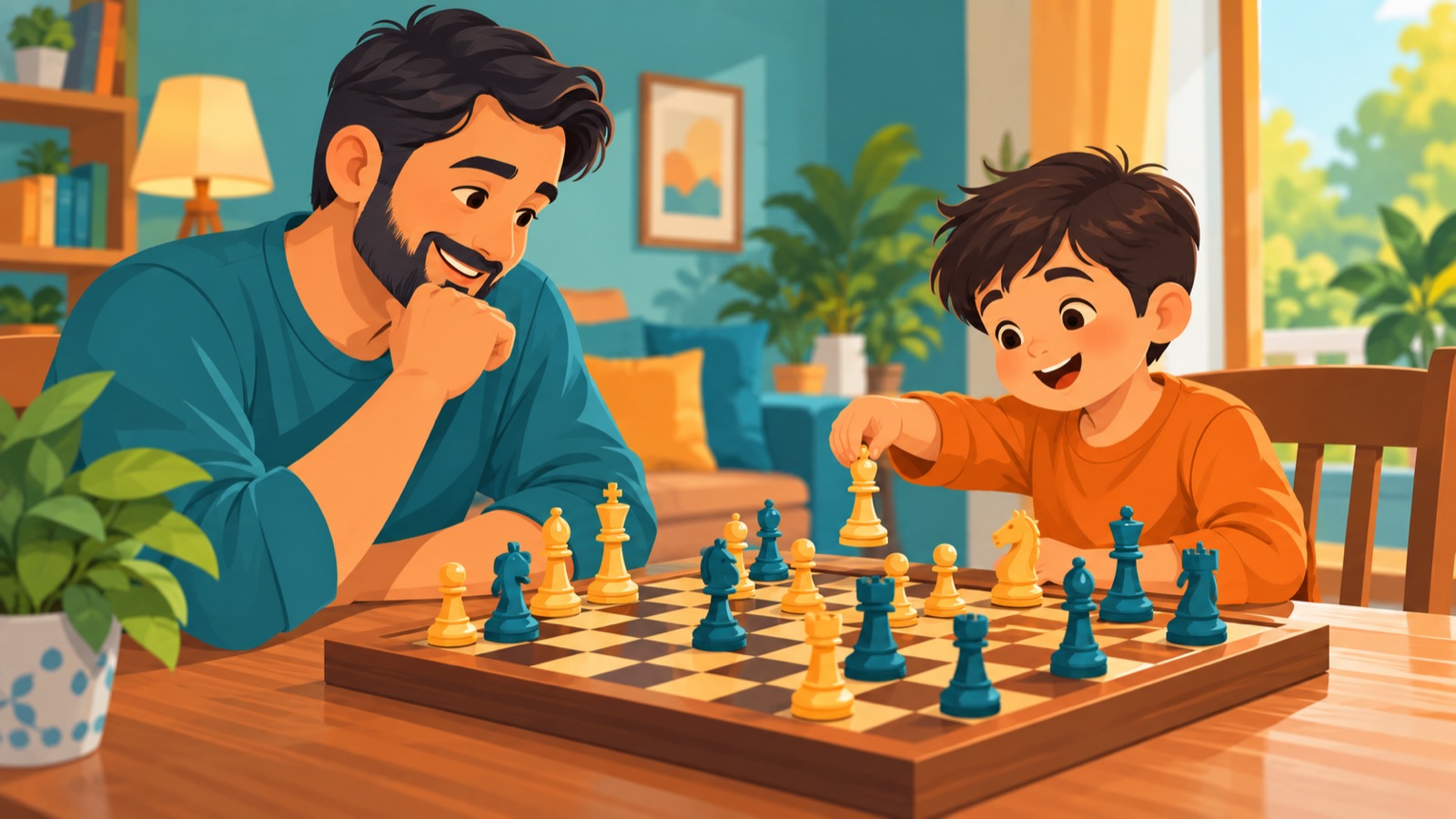
A 6-year-old can learn chess. Many children start between the ages of five and seven, as long as the lessons are short and playful. The easiest way is to teach one piece at a time through small games, such as a game with only pawns, before ever playing a full game. This guide gives you a step-by-step plan, mini-games for each piece, and tips for practising without pressure.
Short answer: start with the board and the pawns, add one piece every few days, play short games often, and keep it fun.
Is 6 Too Young to Learn Chess?
No. At six, most children can follow simple rules, take turns and think a move or two ahead. What matters more than age is whether your child enjoys it. Signs your child is ready:
- They can sit and focus on a game for 10 minutes
- They are curious about the board and the pieces
- They can take turns and cope, mostly, with losing
If your child gets frustrated, pause and come back in a few weeks. There is no hurry.
What You Need
- A real chess board. A physical board with pieces is easier for young children than a screen, because they can pick up and move the pieces.
- A quiet 10–15 minutes, three or four times a week.
- Patience. Children learn by playing a lot of short games, not by listening to long explanations.
Step 1: Set Up the Board
Teach these two rules first, and the board is always right:
- White square on the right. Every player should have a light square in the bottom-right corner.
- The queen goes on her own colour. The white queen starts on a light square, and the black queen starts on a dark square.
Then set up the pieces. The rooks go in the corners, the knights next to them, then the bishops, then the queen and king in the middle. All eight pawns stand in front. Let your child set up the board themselves each time. It is the first memory game of chess.
Step 2: Teach the Pieces, One at a Time
Do not teach all six pieces in one sitting. Add a new one every few days, once the last one feels easy.
| Step | Piece | How it moves | Easy way to explain |
|---|---|---|---|
| 1 | Pawn | One step forward (two on its first move). It captures diagonally. | “Pawns walk forward but fight sideways.” |
| 2 | Rook | Any number of squares in a straight line. | “The rook is a tower that drives in straight lines.” |
| 3 | Bishop | Any number of squares diagonally. | “The bishop slides along the diagonals and stays on one colour.” |
| 4 | Queen | Like a rook and a bishop combined. | “The queen is the most powerful piece.” |
| 5 | Knight | Two squares in one direction and one to the side, in an L shape. It jumps over pieces. | “The knight jumps in an L.” |
| 6 | King | One square in any direction. | “The king is the piece you must protect.” |
Step 3: Play Mini-Games Before Full Games
Mini-games let children practise one idea at a time, and they are far more fun than a lecture.
- Pawn Wars. Put only the pawns on the board. The first player to get a pawn to the other end wins. This teaches how pawns move and capture.
- Capture the Pawns. Place one rook on the board and a few pawns on the other side. Can your child capture all the pawns in as few moves as possible?
- Bishop Hunt. Put a bishop and a few pawns on one colour. The goal is to capture them all.
- Knight Jumps. Place a knight on one corner and ask your child to move it to the opposite corner, one jump at a time.
- Save the King. Set up a king that is in check and ask your child to find a safe move.
Step 4: Teach Check and Checkmate
Explain check as “the king is being attacked”. When a king is in check, the player must get out of check by moving the king, blocking the attack or capturing the attacker. If there is no way out, it is checkmate and the game ends.
Start with very simple checkmates. Show a position where your queen and king trap the other king in a corner, and let your child find the final move.
Step 5: Play Short Full Games
Once your child knows how the pieces move, play full games. Leave out the tricky rules at first: castling, en passant and pawn promotion can come later. Promotion is easy to add, since a pawn that reaches the far end can become a queen (or another piece), which children love.
When you play, use two simple rules:
- Stop, look, think. Before every move, check if your piece is safe and what your opponent is threatening.
- Trade fairly. Chess pieces have rough values: pawn 1, knight 3, bishop 3, rook 5, queen 9. Swapping a knight for a bishop is fair, but giving up a queen for a pawn is not.
A Simple Practice Routine
| How often | How long | What to do |
|---|---|---|
| 3–4 times a week | 10–15 minutes | One mini-game, then one short game |
| Once a week | 20 minutes | A full game, then talk about one good move and one lesson |
Let your child win sometimes, but not every time. Winning too easily is dull, and losing all the time is discouraging. Praise good thinking, such as “I like how you protected your knight”, rather than just the result.
Practising With an App
Once your child knows the moves, a chess app can give them more practice when you are busy. Chess Offline: Play vs AI works without internet, with three difficulty levels (Easy, Medium and Hard) and a local 2-player mode for playing together on one phone. According to its Play Store listing, it also has an unlimited time option with no clock, which is useful for beginners who need time to think. Move quality ratings (Excellent, Good, Inaccuracy, Blunder) and a replay of every game let you sit together afterwards and look at where the game turned.
Start your child on Easy, and keep screen sessions short. For more ideas on balancing screens with hands-on play, see why offline kids apps beat YouTube.
5 Common Mistakes to Avoid
- Teaching too much at once. Add one piece or one idea at a time.
- Playing only against a computer. Playing with you or a friend is more fun and teaches sportsmanship.
- Correcting every move. Let your child make mistakes and learn from them, and comment on one or two key moments after the game.
- Rushing. Chess is a slow game, and thinking time is part of learning.
- Making it a chore. If it stops being fun, take a break and try a different mini-game.
More Brain-Building Play
Chess is one of several quiet, thinking games that children enjoy. If your child also likes puzzles, read the benefits of solving jigsaw puzzles, and for number games at home see our fun math activities for kids.
FAQ
What is the best age to start teaching chess? Many children start at five to seven, but there is no single right age. What matters is that your child can focus for a few minutes and enjoys the game.
Which chess piece should I teach first? The pawn, because it is the most common piece and it teaches the basic ideas of moving and capturing.
How long does it take a child to learn chess? Most children can learn how all the pieces move in a few weeks of short practice. Playing well takes much longer, and that is part of the fun.
Do I need a coach to teach my child chess? No. As a parent, you can teach the basics with this plan. If your child becomes keen, a local club or coach can help later.
How do I explain checkmate to a young child? Say that checkmate means the king is attacked and has nowhere safe to go. Show a very simple example with a queen and a king, and let your child find the final move.
Is it okay for kids to play chess on a phone? Yes, in moderation. A phone is useful for practice, but playing on a real board with a person builds social skills too.
Want a chess opponent that works without internet? Try Chess Offline: Play vs AI, with three difficulty levels and a 2-player mode for playing together.