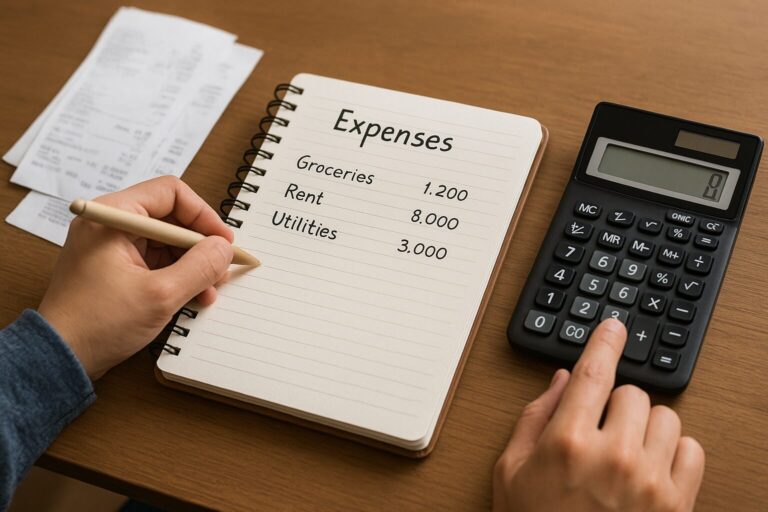
The simplest way to split trip expenses is to let people pay as they go, record every expense with who paid and who shared it, add up each person’s total, and settle the differences at the end. Divide the total by the number of people, compare it with what each person actually paid, and those who paid less send money to those who paid more. This guide shows 4 ways to split, a worked example with exact amounts, and the rules to agree on before you leave.
Short answer: agree on the rules before the trip, record expenses the same day, and settle up within a week.
Why Trip Money Gets Awkward
On a group trip, one friend pays for the hotel, another pays for the cab and a third pays for dinner. Weeks later nobody remembers who paid for what, and small amounts turn into awkward chats. Most fights come from three things: unclear rules, forgotten expenses and delayed settling. All three can be fixed with a little structure.
4 Ways to Split Expenses
1. Equal Split
Add up all shared expenses and divide by the number of people. It is the simplest method and works well when everyone uses the same things, like a shared hotel room and shared meals.
2. Split by Share
If a family of three travels with two friends, an equal split per head may not feel fair. Give each person a share, such as 1 for an adult and 0.5 for a young child, and divide the total by the total number of shares.
3. Split by Item
For bigger differences, such as one person ordering an expensive meal or skipping an activity, assign each expense only to the people who used it. This is the most accurate method and takes the most effort.
4. One Person Pays, Everyone Settles
One friend pays for everything on a card and the others send their share. It is easy to track, but it puts a heavy bill on one person, so rotate the role between trips.
A Worked Example: 4 Friends on a Goa Trip
Four friends, Aman, Bela, Chirag and Divya, go on a weekend trip. They split everything equally.
| Expense | Paid by | Amount |
|---|---|---|
| Hotel | Aman | ₹24,000 |
| Cabs and fuel | Bela | ₹6,000 |
| Food | Chirag | ₹12,000 |
| Activities | Divya | ₹8,000 |
| Total | ₹50,000 |
Each person’s fair share: ₹50,000 divided by 4 is ₹12,500.
| Person | Paid | Fair share | Balance |
|---|---|---|---|
| Aman | ₹24,000 | ₹12,500 | gets back ₹11,500 |
| Bela | ₹6,000 | ₹12,500 | owes ₹6,500 |
| Chirag | ₹12,000 | ₹12,500 | owes ₹500 |
| Divya | ₹8,000 | ₹12,500 | owes ₹4,500 |
Settling up: the three people who owe money each pay Aman. Bela sends ₹6,500, Chirag sends ₹500 and Divya sends ₹4,500, a total of ₹11,500. Three UPI payments settle the whole trip, and nobody has to pay anyone else.
The check: the balances must add up to zero. Here ₹11,500 is owed to Aman, and ₹6,500 + ₹500 + ₹4,500 equals ₹11,500.
Example 2: Splitting by Share
A family of three (two adults and a child counted as half a share) travels with two friends. The shares are 2.5 for the family and 1 each for the friends, a total of 4.5 shares. If the trip costs ₹45,000, each share is ₹10,000.
- The family pays ₹25,000.
- Each friend pays ₹10,000.
The rule about children’s shares is something you agree on before the trip, not after.
7 Rules to Agree on Before You Leave
- What is shared and what is personal? Decide whether drinks, souvenirs, spa treatments and extra activities are shared costs or paid individually.
- Who pays big bills? Pick someone to pay the hotel and the cabs, and rotate the role over time.
- How do you split meals? Equal share is the easiest, but agree on a rule for people who skip a meal or eat much more.
- What about tips and taxes? Include them in the bill, so the numbers add up.
- When do you settle? Agree on a date, such as within a week of getting home.
- How do you pay? UPI is the quickest, so ask everyone to share their UPI ID before the trip.
- How do you handle children and couples? Decide how shares work for families, as in the example above.
Tips to Keep Things Smooth
- Record expenses the same day. By the evening, nobody remembers what the auto cost in the morning.
- Round to whole rupees. Paise make the sums messy without making them any fairer.
- Keep photos of big bills. They settle any question about a number.
- Use one place to track everything. A shared note works, but an app that does the maths for you is easier. Our post on why writing down your expenses is key to financial freedom explains why tracking matters even for small amounts.
- Settle quickly. The longer you wait, the more awkward the conversation becomes.
Track It Without the Maths
If you do not want to do this by hand, SplitEase: Split Bills & Trips is built for exactly this. According to its Play Store listing, you can:
- Split a bill in seconds. Enter the amount, choose how many people and add a tip if you like.
- Create a trip for your group. Add the people, then log expenses as they happen, with who paid and who shared each one.
- See who owes whom. The app keeps a running balance after every expense.
- Keep an itemised history for every trip.
- Work in rupees, rounded to whole rupees.
- Use it offline, with sign-in optional. You can share a trip with a join link and sync across devices if you sign in.
FAQ
What is the fairest way to split trip expenses? For most friend groups, an equal split of shared costs is the fairest and simplest. If some people use much less or more, split by item or by share.
How do we split costs if someone skips an activity? Record that activity only against the people who took part. Tracking expenses by who shared them makes this easy.
How do we split a bill with a different number of people at each meal? Record each meal with only the people who ate it. The running balance then adjusts for every expense.
Should the person who booked the hotel pay everything? It is common for one person to pay the big bills, but everyone should share the cost. Rotate the role between trips so the same person does not carry the load every time.
How do we settle up after a trip? Work out each person’s total, compare it with their fair share, and have the people who owe money pay those who are owed. Using UPI, you can often settle with just a few payments.
What if someone forgets to pay? Send a polite reminder with the amount and the trip name. Agreeing on a settle-by date before the trip makes the reminder easier.
Planning a group trip? Try SplitEase: Split Bills & Trips to track who paid and who owes, so the only thing you argue about is where to eat. For more money tools, see our guide to personal finance calculators for Indians.